
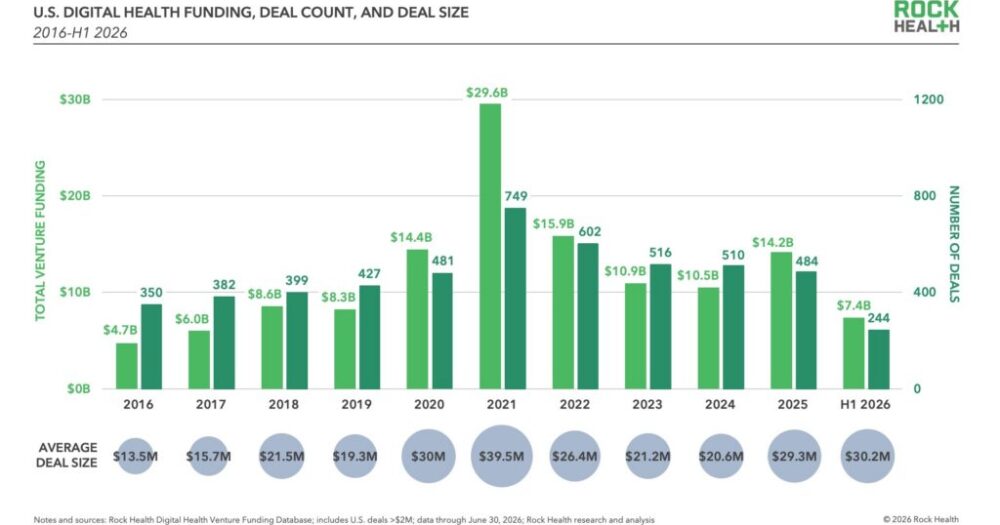
The digital health sector raised $7.4 billion across 244 deals in the first half of 2026, according to Rock Health’s mid-year funding report. That’s $1 billion more than the same period last year, with roughly the same number of deals. After the sector’s post-pandemic hangover in 2023 and 2024, when annual funding sat around $10.5 to $10.9 billion, this year looks set to continue a steady recovery.
But the headline number only tells part of the story. Funding is concentrating fast. Nineteen companies pulled in 20 deals of $100 million or more in H1 2026, and those mega deals absorbed 45% of all capital deployed. That’s up from 22% in all of 2024. In practical terms, just over 8% of deals captured nearly half the money. The median deal size climbed from $12 million to $14 million, the highest since 2022.
Behind the numbers, something more fundamental is shifting. As AI makes it cheaper and faster to build software, the old rules about competitive advantage are breaking down. A great SaaS product used to be enough of a moat. Now it isn’t. Investors and founders are going back to basics, asking harder questions about what actually holds up when any team with access to a frontier model can ship a working product in weeks.
Mental health and obesity attract the most capital
Mental health claimed the top spot for the seventh year running. Big rounds went to Talkiatry ($210 million) and Grow Therapy ($150 million), but investors are also funding the infrastructure that makes behavioral health more scalable, including provider marketplaces and AI-assisted care delivery. The gap between demand and provider supply remains massive, which makes AI-assisted scale appealing. At the same time, concerns about safety and appropriate clinical oversight are real. That’s why investors are backing purpose-built platforms with dedicated clinician supervision, like Jimini Health ($17 million) and The Path ($14.3 million).
Worth noting: consumer adoption of general-purpose AI chatbots for mental health support is outpacing dedicated mental health apps. Startups in this space also face a shifting policy environment, with the Trump administration showing interest in psychedelic-assisted therapy while tightening scrutiny on psychiatric medication prescribing.
Obesity and weight management came in second, driven almost entirely by the GLP-1 boom. Three $100 million-plus rounds anchored the category: eMed, Nourish, and Midi each expanded existing platforms into GLP-1 care. Signos raised $20 million for its over-the-counter continuous glucose monitor and announced a Dexcom partnership. Pharma companies are also moving closer to patients through direct-to-patient channels and partnerships with digital health companies. The Medicare Bridge program, a pilot offering $50/month GLP-1s, opens an affordable path for Medicare recipients. Investor attention is also spreading to adjacent peptide categories, with companies like Superpower ($30 million), Protocole ($6 million), and Feel Peptides ($3 million) all raising in H1. A scheduled FDA peptide reclassification meeting in late July 2026 could significantly affect how these products are marketed and distributed.
One pattern stands out across both categories: nearly two-thirds (64%) of mental health and weight management startups that raised in H1 sell directly to consumers, compared to 29% of all digital health companies. High unmet demand is pushing founders toward the consumer market rather than waiting for health systems or payers to act.
Four ways startups are building real competitive advantage
Rock Health stopped labeling individual startups as “AI-enabled” last quarter. AI is now table stakes. The harder question is what a company has that AI alone can’t provide. Across this year’s deals and investor conversations, four themes kept surfacing.
Founder expertise. Early-stage investors are placing more weight on domain knowledge than ever. As AI lowers the cost of building, founders with real experience inside the organizations they’re selling to can spot the problems worth solving. Clinical or administrative backgrounds help founders understand care team dynamics and operational friction in ways that are hard to fake. Investors are also talking about “good taste,” shorthand for the judgment to know which problems matter and which solutions will actually stick.
As Sean Doolan, Founder and Investor at Virtue, put it: “None of us know what the world is going to look like two years from now. The primary attribute of any pitch that is most fundamental to diligence is the founder. Founder-market fit matters a lot right now. We’ve seen real advantages with founders who understand not just the business function they’re trying to improve, but also the culture and conditions that shape how their customers operate.”
Owning more of the workflow. Some of digital health’s best-funded companies are competing to control larger pieces of the healthcare operating layer. As agentic AI increases the value of coordinating across tasks, companies that oversee more of the workflow have more context, and more context means better coordination. The risk is overlap: as multiple vendors expand beyond their original focus areas, health system customers may start seeing redundant offerings from companies that used to be complementary.
Hands-on implementation. Buyers increasingly expect vendors to help them get results, not just hand over a product and disappear. AI has made tailored implementations more possible but has also raised the stakes for failed deployments. In response, some startups are investing in forward-deployed engineers who work directly with clients to co-build custom workflows inside the customer’s own environment. Well-capitalized companies like Commure and Qualified Health have made this a core part of how they go to market. Anthropic and OpenAI have built out life sciences teams and are doing the same.
Halle Tecco, Rock Health’s founder, noted: “Health systems are leading in AI transformation right now. To think, when we started Rock Health, very few startups sold into hospitals because the sales cycle was long, and most health systems didn’t have the infrastructure or culture to successfully absorb new innovation. Now, if you look at the big AI companies getting funded, most of them are building for health systems. It’s a sign of just how much has changed.”
Network effects and trusted partnerships. Healthcare buyers have more vendor options than they know what to do with. Companies that partner with organizations buyers already trust can reduce the perceived risk of adopting something new. Clinical AI platform Abridge, for example, recently announced partnerships with Nvidia on clinical foundation models, AHIMA on coding standards, the American Diabetes Association, the American Academy of Family Physicians, and smart-room integration companies like Artisight. OpenEvidence has pursued partnerships with medical societies and publishers to put trusted evidence directly into existing clinical workflows. Each partnership makes the product more valuable and the next deal easier to close.
The IPO market is stirring, but hasn’t broken open yet
Digital health has yet to see a public offering in 2026, despite a growing list of companies that look ready. The closest thing so far is wearable maker Oura, which filed the sector’s only S-1 of the year. Oura raised $900 million last October at an $11 billion valuation, roughly 11 times reported revenue, and has had a headline-filled few months since. Whoop also secured $575 million at a $10.1 billion valuation as it prepares for its own eventual listing.
Wearables have matured significantly since Fitbit’s exit more than a decade ago. Today’s leading devices come with deeper data, more personalized analytics, more durable recurring revenue, and increasingly, in-app care offerings alongside integrated lab results and medical records. They’ve become genuine consumer health platforms, not just tracking gadgets.
Among companies already public, results are mixed but improving in spots:
- Tempus reported 36% year-over-year revenue growth in Q1, beating analyst expectations
- Hinge Health, which went public last year, has more than doubled its IPO price as of the end of Q2 2026, posting $182 million in Q1 revenue (up 47% year-over-year) and a 23% free cash flow margin
- GoHealth filed for Chapter 11 bankruptcy and was delisted
- Vicarious Surgical, which went public via SPAC in 2021, was also delisted
M&A is running hot, especially in revenue cycle management
Digital health saw 115 acquisitions in H1 2026, putting the sector on pace to exceed 2025’s full-year total of 199 deals. Q2 was the busiest M&A quarter since Q3 2021, with 71 deals announced. Revenue cycle management was the hottest area:
- IKS Health acquired TruBridge to extend its RCM platform to rural communities
- Med-Metrix completed back-to-back acquisitions of Vitalware and CanAide
- Innovaccer folded CaduceusHealth into its platform
- Thoreau Group signed a $12 billion agreement to take control of RCM company Ensemble Health
Strategic buyers were active too. Roche acquired PathAI to strengthen its diagnostics offering, and Dexcom acquired long-time partner Nutrisense to extend its consumer metabolic health platform. Whether this pace holds through the second half of the year remains to be seen, but the direction is clear: consolidation is accelerating, and both private equity and large incumbents are buying aggressively.