
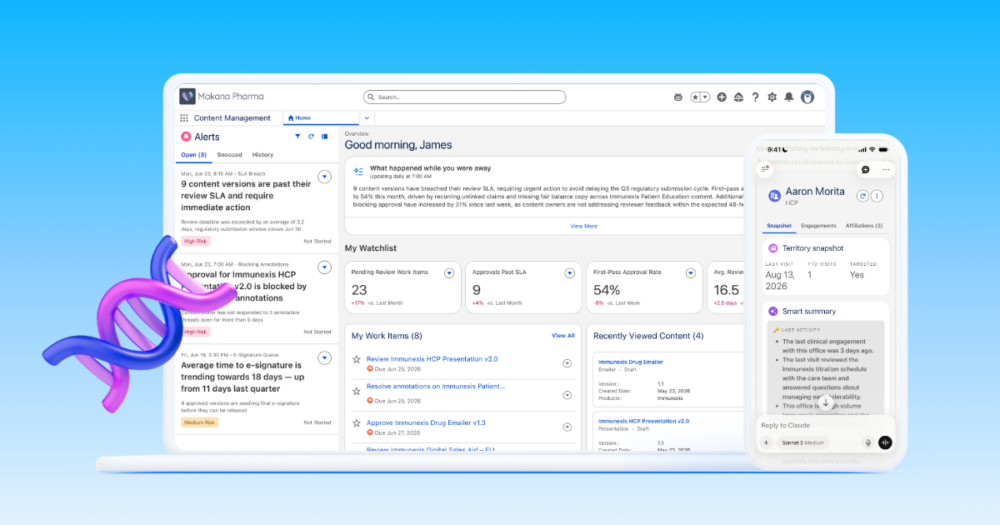
Half of all drug launches underperform their pre-launch forecasts. That single statistic sits at the center of a broader problem Salesforce is trying to address: life sciences organizations that spend more time reacting to failures than preventing them. On September 8, 2026, the company announced three new products designed to shift pharma and medtech teams from reactive workflows toward something more proactive. The question is whether the technology can hold up in the notoriously complex regulatory environments these teams operate in every day.
The three products are Regulated Content Management (RCM), Command Center for Life Sciences, and Life Sciences MCP. Each targets a different operational bottleneck, but they are designed to work together. Salesforce is positioning them as a connected system rather than a set of isolated tools, with compliance logic shared across all three.
Fixing the compliance bottleneck at the source
Medical, Legal, and Regulatory review is one of the most time-consuming parts of pharma marketing. Teams can spend months cycling content through MLR before it reaches the field. RCM tries to move compliance upstream, embedding it during content creation rather than treating it as a final gate.
The core idea is that claims, supporting evidence, references, and market-specific obligations such as Fair Balance requirements are treated as live, interconnected data rather than static documents. AI agents can flag expiring substantiation, identify missing evidence links, and surface potential compliance gaps before a reviewer ever sees the file. Every action is logged against the ALCOA+ standard, which is the attributable, legible, contemporaneous, original, accurate, and complete framework that regulators expect in pharmaceutical documentation. Electronic signatures are 21 CFR Part 11-compliant.
RCM also supports existing infrastructure. Organizations do not need to migrate all content into a single Salesforce repository. The system can connect to existing digital asset management platforms, content management systems, and authoring tools while maintaining governed compliance relationships in the background. That matters for larger organizations with years of established tooling they are not ready to replace.
What Command Center actually does
Command Center for Life Sciences is the operational monitoring layer. It pulls together omnichannel engagement data, market sentiment, and revenue trends into one view, then uses anomaly detection to flag deviations before they compound. A spike in safety signals, a slowdown in medtech device adoption, or a drop in patient adherence can be identified, traced to a root cause, and linked to a recommended action, all within the same interface.
The predictive modeling component, built on Tableau Next, lets leaders run scenario analysis. A commercial lead could model the impact of increasing medical science liaison hours in a specific region, or simulate what happens when field rep coverage is reallocated in response to a competitor’s launch. These are the kinds of decisions that currently depend on analysts pulling data manually across disconnected systems.
The Command Center Agent can execute resolution workflows or queue them for human approval, including via Slack. And there is a direct connection to RCM: when medical affairs surfaces new clinical evidence, Command Center can generate content action plans that feed back into the regulated content workflow.
Extending intelligence beyond the Salesforce interface
Life Sciences MCP addresses a practical reality: most teams do not work in a single platform all day. Field reps, CRO partners, clinical operations staff, and commercial teams use a mix of tools, from Microsoft Teams and Slack to WhatsApp and external partner portals.
Life Sciences MCP extends Agentforce Life Sciences to those environments through the Model Context Protocol standard, meaning governed workflows and compliance logic follow the user regardless of where they are working. Built-in controls include:
- PII masking across all surfaces
- Zero data retention policies
- HIPAA compliance
- GxP and 21 CFR Part 11 controls
The architecture is designed so organizations build compliance logic once and deploy it across Claude, Gemini, Teams, or any MCP-compatible environment, rather than rebuilding governance rules for each channel separately.
Why this matters now
Pharma and medtech companies have invested heavily in CRM and data infrastructure over the past decade, but much of that investment produced better reporting rather than faster action. The gap between a signal appearing in the data and a coordinated response reaching the field remains wide. Salesforce is betting that agentic AI, combined with embedded compliance architecture, can close that gap in a way that earlier automation attempts did not.
Pricing and availability details were not disclosed at launch. The products were previewed at Dreamforce 2026. Organizations evaluating these tools will want to scrutinize how the compliance audit trails hold up under regulatory inspection and whether the anomaly detection performs reliably across the messy, fragmented data environments most life sciences companies actually have.