
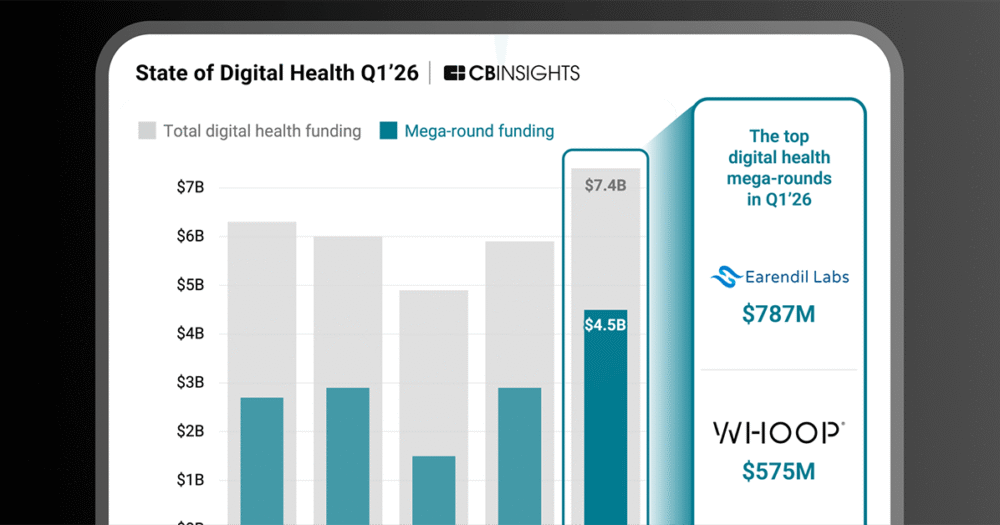
Digital health started 2026 with strong momentum, but the money is flowing to a smaller circle of winners. Funding climbed to $7.4 billion in Q1 2026, up from $5.9 billion in Q4 2025 and reaching the highest level since Q2 2022.
The catch? Most of that money went to just 19 mega-rounds worth $100 million or more. These deals captured 60% of all funding – the highest share in recent quarters. Average deal size jumped 46% year-over-year to $29.6 million as investors made fewer but bigger bets on companies with proven scale.
Winners pull away from the pack
The data shows a sector reorganizing around a shrinking pool of proven companies. Q1’s late-stage median deal size of $108 million more than doubled Q4’s median of $48 million. After Q4 2025 produced just one new unicorn, Q1 2026 added eight – the most since Q2 2022.
Companies like Devoted Health and Alan now sit on war chests exceeding $100 million. This gives them the resources to stay private longer, build distribution, and acquire competitors rather than get acquired themselves. Whether digital health’s recovery extends beyond these top performers remains the key question for 2026.
M&A activity surges with focus on commercial success
Digital health M&A deal count jumped to 56 in Q1 2026, up 47% from 38 deals in Q4 2025. The quarter drew a clear line for valuations: regulatory approval gets you in the door, but commercial adoption drives the price.
Abbott’s $23 billion acquisition of Exact Sciences proves this point. Exact Sciences’ Cologuard had already demonstrated commercial success with 20 million colorectal cancer screenings, Medicare coverage, and backing from major clinical guidelines. Abbott paid a premium to take that proven model global through its international network.
The radiology AI sector shows this valuation gap clearly:
- DeepHealth’s $269 million acquisition of Gleamer reflected broad adoption across 700+ hospitals in 44 countries and $30 million in projected 2026 revenue
- Oxipit, despite achieving the world’s first CE Class IIb certification for fully autonomous chest X-ray interpretation, generated just $27,600 in revenue in 2024
CMS deadline drives prior authorization investment
A federal rule requiring health insurers to make prior authorization fully electronic by January 2027 is reshaping investment priorities. With nine months until the deadline, companies are scrambling to comply or capitalize.
The investment activity spans the full spectrum. Latent raised $80 million in Series A funding as a prior authorization specialist, while Adonis secured $40 million in Series C for its broader revenue cycle platform. Collectly’s acquisition of Pledge Health showed companies buying prior authorization capabilities rather than building them.
Partnership deals followed the same trend. Abridge and Availity teamed up to embed prior authorization into clinical workflows, while Samsung and b.well integrated Galaxy smartphones with health records to align with the CMS initiative.
Pharma bets billions on AI drug discovery
AI drug discovery dominated digital health deals in Q1 2026, but split into two distinct approaches. Large pharma companies doubled down on scaled platforms that can compress R&D timelines:
- Earendil Labs raised $787 million – Q1’s biggest digital health deal – backed by Pfizer and Sanofi, with 40+ therapeutic programs generated in under five years
- Takeda committed up to $1.7 billion to Iambic Therapeutics, whose platform moved a drug from concept to clinical trial application in 24 months versus the typical six years
Meanwhile, early-stage investors focused on platforms building entirely new drug classes. The largest rounds went to Proxima ($80 million for molecular glues), Vibrant Therapeutics ($61 million for macromolecular therapeutics), and Congruence Therapeutics ($39.5 million for allosteric modulators).
Healthcare AI hiring accelerates
Healthcare AI companies showed the biggest headcount growth in digital health over the past 12 months. Tennr and Hippocratic AI led the expansion as the market moves beyond early development into enterprise deployment and specialized workflows.
Tennr’s hiring indicates a push into larger health systems and academic medical centers, plus expansion into specialized areas like durable medical equipment and radiology. Hippocratic AI appears to be moving beyond provider workflows into pharma and medtech R&D following its Grove acquisition.
The competition is intensifying beyond startups. Anthropic grew headcount by over 200% in the last 12 months and launched its healthcare offering within days of OpenAI’s announcement. Nvidia recorded six new digital health business relationships in Q1 2026 while expanding healthcare-focused hiring with roles like “Global Head of Business Development, Digital Health.”
These moves suggest healthcare AI will become an even more contested market in 2026, with accelerating competition across enterprise sales, regulatory compliance, and specialized clinical applications. The sector’s momentum appears strong, but the benefits are concentrating among fewer, better-funded players.