
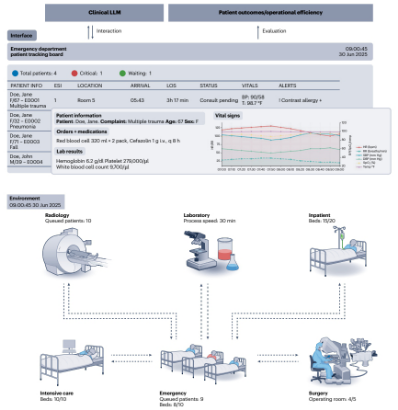
Doctors might soon have AI assistants that have been thoroughly tested in a virtual hospital before they ever see a real patient. Researchers from Seoul National University Hospital and Harvard Medical School have built what they call the world’s first “Clinical Environment Simulator” – essentially a flight simulator for medical AI.
The system tests how AI decisions play out in a complete virtual hospital, tracking everything from patient outcomes to whether the emergency room gets backed up. It’s a major step beyond current AI testing, which typically involves feeding historical data to AI systems and checking if they get the right diagnosis.
How does it work?
The simulator runs two engines simultaneously to create a realistic hospital environment. The Patient Engine generates virtual patients whose conditions change over time, just like real patients. It uses disease templates created by specialists and draws from actual electronic medical records to simulate how symptoms might progress or how patients might respond to treatments.
The Hospital Engine tracks all the hospital’s resources in real time:
- Available beds and their current status
- Medical staff schedules and assignments
- Equipment like CT scanners and their wait times
- Priority systems that give critically ill patients first access to resources
When the AI orders a blood test, the simulator assigns the necessary staff step by step, following the actual time requirements. If the AI delays ordering diagnostic tests, a patient with stable chest pain might deteriorate into a heart attack. If it prioritizes a CT scan for one emergency patient, other patients face longer wait times.
Why does it matter?
Current medical AI testing misses the bigger picture. Researchers test whether AI can correctly diagnose pneumonia from an X-ray, but they don’t test what happens when that AI is making decisions in a busy emergency room with limited staff and equipment.
The simulator measures AI performance using a dual scoring system:
- Patient outcomes: survival rates, treatment timing, and adherence to medical guidelines
- Hospital efficiency: length of stay, emergency room throughput, and resource utilization
This approach rewards AI decisions that help individual patients without creating bottlenecks that harm other patients. The system also runs stress tests, simulating extreme scenarios like network failures or multiple emergencies hitting the hospital at once.
Research Professor Seong-Eun Kim notes that while virtual hospitals can’t perfectly predict human physiology, this represents the most practical next step for testing AI in realistic medical environments.
The context
Medical AI has shown impressive results in controlled laboratory settings, but real hospitals are complex systems where every decision has ripple effects. A single AI recommendation can affect not just one patient, but the entire flow of the hospital.
The research, published in Nature Medicine, addresses a critical gap as healthcare systems worldwide consider deploying AI assistants more broadly. Just as pilots train extensively in simulators before flying real planes, this system lets medical AI train in virtual hospitals before working with real patients.
The researchers believe this could be the missing piece that allows doctors to step away from computer screens and return their focus to patient care, knowing their AI assistants have been thoroughly tested in realistic scenarios.