
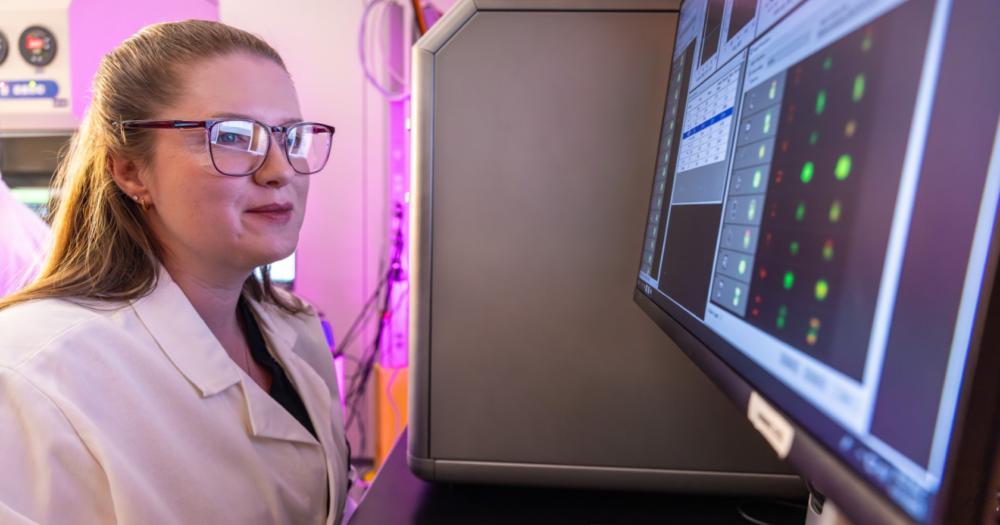
Erin Davis calls it the “SuperDuperPOD.” That name tells you two things at once: Bristol Myers Squibb already runs one of the largest AI clusters in life sciences, and they are not slowing down. The pharmaceutical company announced this week that it is deploying a second NVIDIA DGX SuperPOD, built on eight DGX Vera Rubin NVL72 systems, which together form what the company says is the most powerful and energy-efficient AI cluster in the life sciences industry.
The new system delivers up to 10 times the performance per megawatt of the infrastructure it replaces. But raw compute power is not the point. The point, according to Davis, vice president of research business insights and technology at BMS, is access. “Instead of equipping a small group of researchers with access to the supercomputer, we’re opening it up to literally every scientist,” she says. “No one has to wait, and no one is told they have a limit.”
From abstract potential to measurable results
BMS has operated its first DGX SuperPOD for about three years, and the results are already concrete. AI-enabled target identification saves scientists weeks of manual work. The company has used AI to expand its library of CELMoD compounds, molecules engineered to selectively degrade cancer-causing proteins, with applications in blood cancer and beyond. And through a methodology that Payal Sheth, senior vice president of therapeutic discovery sciences at BMS, calls “Predict First,” AI is used during lead optimization to prioritize which molecules are worth synthesizing at all.
“We use predictions as a way to prioritize synthesis of molecules with multi-parameter optimization,” Sheth explains, “to weed out molecules that wouldn’t meet the property profile we’re working towards.” The goal is to make sure that expensive laboratory experiments are spent only on molecules with a real chance of success. That’s a meaningful shift in how drug discovery resources get allocated.
Sheth, who spent her career inside drug discovery labs before moving into her broader leadership role in January, is direct about what the mandate is now: moving from “this abstract position of what AI can do to actually translating that to measurable impact.”
Why compute is the bottleneck, not the science
BMS is not buying more compute because it can. It’s buying it because the current system is already saturated. “We’re in production with some very large-scale predictions around large molecules,” Davis says. “We’re building our own foundational models, and that takes a lot of GPUs.”
The new DGX Vera Rubin NVL72 systems will be combined with the existing SuperPOD into a single unified environment, accessible from every BMS site globally. Researchers in Lawrenceville, New Jersey will be able to feed datasets into models that a team in San Diego can draw on immediately. Site-specific access restrictions left over from past acquisitions are being replaced with AI-native tooling managed through NVIDIA Mission Control. Scientists will be able to initiate complex predictions in plain English, without needing deep computational expertise to get started.
The platform also includes NVIDIA’s BioNeMo Agent Toolkit, which supports agentic workflows across the full drug discovery pipeline. That matters because AI agents can pull from data across programs and therapeutic areas simultaneously, something that siloed research structures historically made very difficult. “Agents don’t care,” Davis says. “They go all across. And that is a huge game-changer because now we can learn from decisions across the silos and across programs.”
The cumulative learning loop that didn’t exist before
Sheth points to something that gets less attention than the compute numbers but may be more important over time: compounding institutional knowledge. Early in her career, every drug discovery project was treated as its own discrete effort. Learnings from one program rarely fed the next in any structured way.
That’s changed. “There’s a cumulative learning loop today in drug discovery that did not exist when I first started my career,” she says. Every experiment, clinical readout, and research partnership now has the potential to sharpen the next scientific decision. The new infrastructure is designed to make that loop faster and wider.
Still, both Davis and Sheth are clear that AI is not replacing scientific judgment. Human instincts, Sheth says, “are augmented with more quantitative insights and predictions.” Davis puts it bluntly: “You still have to have that human brain driving things, still looking for caveats and gotchas.”
What this means for the industry
BMS is not the only major pharma company investing heavily in AI infrastructure, but the scale and specificity of this deployment is notable. The combination of foundation model training, agentic workflows, and open access for all researchers, not just computational specialists, reflects a broader shift in how the industry thinks about AI integration. It’s no longer a specialized tool sitting in one corner of R&D. It’s becoming the connective tissue of the entire research organization.
Davis already has the pitch ready for scientists thinking about where to do their best work: “Welcome to Limitless Compute.” When BMS Chief Digital and Technology Officer Greg Meyers asked whether she could even saturate the new system, her answer was simple. “Just give us time.”