
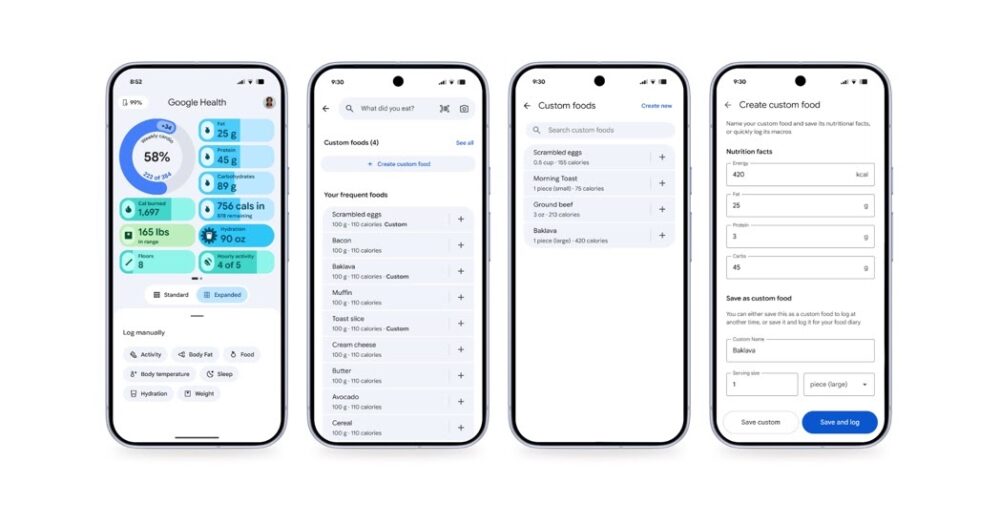
Google has started rolling out version 5.04 of its Google Health app for both Android and iOS. The update, announced by Community Manager Stefanie Frederick on the Google Health Community forum, brings a handful of improvements across nutrition logging, sleep tracking, cycle health, and fitness data. The rollout is happening in phases over about a week, with timing varying by carrier and device.
The update is the fourth in a series of incremental releases following versions 5.01, 5.02, and 5.03, suggesting Google is now shipping Google Health updates at a faster pace. That cadence reflects a broader push in the health tech space, where Apple, Samsung, and others are all competing to make their health platforms stickier by adding more granular tracking tools.
Not everyone is celebrating the new features, though. The comments section under the announcement quickly filled with users asking Google to fix existing bugs before shipping new functionality, particularly around Fitbit device syncing issues that have apparently been left unresolved for some time.
What’s new in version 5.04
The headline addition is custom food logging in the nutrition section. Users can now create, edit, and delete their own food entries, search for them later, and re-log them easily. There’s also a new quick-logging option that lets you record calories and macronutrients without having to search for a specific food name first. A bug affecting how macronutrients were calculated as a percentage of total calories has also been fixed.
On the sleep side, naps now count toward your total sleep duration on the Today tab. Sleep tracking in health apps has historically treated naps as separate data, so folding them into the daily total is a practical change for users who rely on nap data for a fuller picture of their rest.
Other fixes and updates in this release include:
- Heart rate charts and maps in exercise summaries were sometimes showing incomplete data, cutting off before the workout ended. That’s now fixed.
- Cycle history can now be viewed grouped by year, making it easier to spot long-term patterns.
- An iOS bug that stopped some users from sending friend requests has been resolved.
Users want Fitbit fixes, not new features
The user response to the update was blunt. Multiple commenters reported that their Fitbit devices, including the Fitbit Aria Air smart scales, still don’t sync properly with Google Health. One user, Les Bell, pointed out the obvious irony: Google acquired Fitbit in 2021 for about $2.1 billion, yet its own hardware still doesn’t reliably talk to its own health app.
Step counting accuracy is another sore point. At least one user reported getting hundreds of phantom steps just from routine morning movements, and said their Apple Watch handled the same situation far better. Others reported that sleep tracking had simply stopped working for several days, with some blaming a previous update.
There are also missing features that users want back. Several people mentioned that the map integration from the old Google Fit app, which showed detailed trail data during workouts, hasn’t made it into Google Health. Google officially retired Google Fit in early 2024, migrating users to the newer Google Health app, but that transition has clearly left some gaps.
Localization gaps are limiting the app’s reach
A few international users flagged that parts of the app still aren’t fully translated. One user in Turkey noted that the lack of Turkish language support makes the Health Coach assistant difficult to use in a meaningful way. Another reported seeing nutrition measurements displayed in a foreign language. For a health app where understanding the data matters, translation gaps aren’t a minor inconvenience.
What’s still missing
Users are also asking for more detailed micronutrient tracking in custom foods. Right now, custom entries support calories and macros, but not fiber, sugar, or vitamins and minerals. Given that fiber deficiency is a widespread issue, the omission stands out. Whether Google plans to expand custom food fields in a future release hasn’t been addressed.
Google says more updates are coming in the weeks ahead. Whether those will tackle the Fitbit integration problems or add more new features first remains to be seen.