
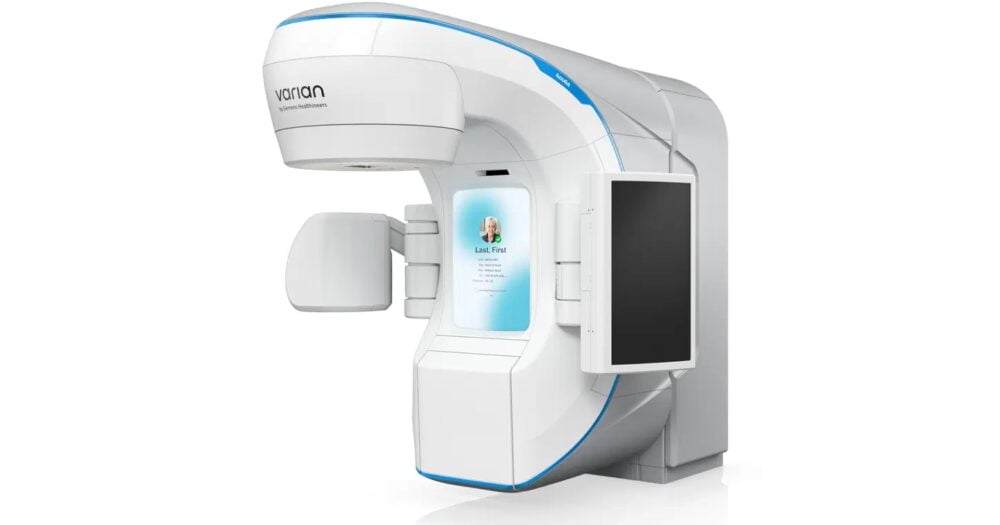
Multi-site stereotactic body radiotherapy in as little as 60 seconds. That’s the headline claim behind Accela, the new radiotherapy system Siemens Healthineers launched this week through its cancer-care division, Varian. If that number holds up in broad clinical use, it represents a meaningful shift in how radiotherapy departments manage throughput, patient comfort, and treatment complexity.
What Accela actually is
Accela is a linear accelerator built around NeoArc, a new hardware architecture that Siemens Healthineers describes as the foundation of the entire system. The machine is designed to handle a wide range of cases while making complex treatments faster and more accessible for centers that may not have the staffing or scheduling capacity to run long treatment sessions.
The technical specifications are notable. Accela includes a large HyperSight cone-beam CT imaging panel, a newly designed multi-leaf collimator, gantry rotation at 2.5 RPM, dose rates up to 40 Gy/min, and a new eight-megavolt flattening filter-free energy setting. The planning software uses AI and advanced algorithms to balance plan quality against delivery speed, which has historically been a difficult trade-off for clinical teams to manage manually.
Why speed matters here
Stereotactic treatments require patients to hold extremely still, often while holding their breath, so the tumor target doesn’t shift during irradiation. Shorter delivery times reduce the chance of movement, reduce patient distress, and make it practically possible to treat multiple sites in a single session. For patients with metastatic disease, that matters a great deal.
Dee Khuntia, chief medical officer at Varian, framed the significance this way: “It’s faster than previous systems, it’s built on a fundamentally modern architecture, and it introduces a generational shift in treatment planning. But what excites me most is its potential to alter the biological response to radiotherapy. That’s not incremental progress; it’s a new chapter.” The biological angle is worth watching. Ultra-high dose rates, sometimes called FLASH radiotherapy, have shown promise in preclinical work for sparing healthy tissue. Whether Accela’s dose rates translate to that kind of biological benefit in patients is a question ongoing research will need to answer.
The clinical input behind it
The system wasn’t developed in isolation. Siemens Healthineers worked with an advisory group of seven major cancer institutions over the course of eight years:
- Mayo Clinic
- Washington University School of Medicine Siteman Cancer Center
- University Hospital Zurich
- Seidman Cancer Center at University Hospitals Cleveland Medical Center
- Maastro, Maastricht Radiation Oncology Institute
- Mass General Brigham Cancer Center
- Memorial Sloan Kettering Cancer Center
That depth of clinical collaboration during development, rather than after product launch, is genuinely unusual. It suggests the engineering decisions were stress-tested against real workflow constraints and patient scenarios, not just optimized for marketing specifications.
The broader context for radiation oncology
Cancer incidence is rising globally. Radiation oncology departments are under pressure from higher caseloads, more complex treatment regimens, and persistent workforce shortages. A system that can treat more patients per day, with less time per session and without sacrificing precision, addresses a real operational problem. So the clinical case for faster, high-dose-rate linac technology is not theoretical. The question for procurement teams will be whether Accela’s performance in routine clinical settings matches what its launch specifications promise.