
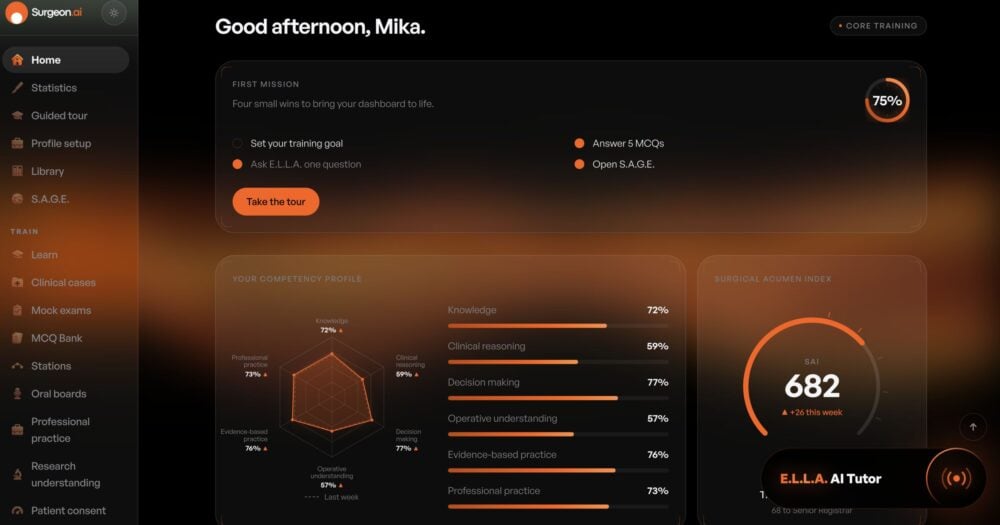
Surgical education has always been postcode-dependent. Where you train, who mentors you, and which cases happen to come through the door on a given rotation, these factors shape careers in ways that have little to do with raw ability. Professor Shafi Ahmed, surgeon and health technology innovator, is betting that artificial intelligence can start to change that equation. His new platform, Surgeon.AI, launched publicly while he was delivering the Sir Peter Freyer Memorial Lecture in Galway, and it is aimed squarely at the global gap between surgical talent and surgical opportunity.
What the platform actually does
At the centre of Surgeon.AI is ELLA, the Education, Learning and Language Agent. It is an AI companion built specifically for surgical learners, designed to support questioning, explanation, reflection, and personalised learning across every stage of a surgical career, from medical school through to consultant or attending level.
ELLA works across three connected systems:
- SurgeonOS — a learning environment covering surgical knowledge, examination preparation, interactive clinical content, and professional development
- SurgeonGPS — a career guidance system that maps where a surgeon is in their professional journey and what to focus on next
- SurgeonIE — an intelligence engine connecting surgeons with education, mentorship, opportunities, and collaboration beyond their immediate institution
The idea is that the platform becomes more personalised the longer a surgeon uses it. That’s an ambitious technical claim, and one that will take time to validate at scale. But the architecture at least reflects a serious attempt to move beyond static course libraries or one-size-fits-all question banks.
Tracking development beyond exam results
Launching alongside ELLA is the Surgical Acumen Index, a proprietary algorithm designed to track surgical development over time. Rather than reducing progress to pass or fail, the index measures across six areas: knowledge, clinical reasoning, decision making, operative understanding, evidence-based practice, and professional practice.
The index is meant to evolve as the surgeon does, identifying strengths and flagging gaps rather than delivering a single snapshot score. It is worth being clear about what this is and what it is not. The Surgical Acumen Index is an educational tool. It is not a replacement for formal examinations, competency assessments, or clinical credentialing, and the platform makes that distinction explicit.
Why this matters beyond the launch
Ahmed has spent years testing the edges of surgical education technology, from livestreaming operations in virtual reality to immersive mixed reality training. Surgeon.AI represents a move from spectacle to infrastructure, from demonstration projects to a system that a trainee might actually use every day.
The initial focus is surgical trainees and examination preparation, with plans to expand across specialties, training systems, and countries. The longer-term goal is lifelong support, from early training through to specialist practice.
“Talent is distributed globally,” Ahmed said. “Opportunity is not.” That single line captures the problem this platform is trying to address. Whether Surgeon.AI can deliver on it at global scale is a question that only adoption, and honest outcome data, will answer. But the clinical and educational logic behind it is sound. And for trainees working in under-resourced settings without reliable access to senior supervision, even a well-designed AI companion could make a meaningful difference.