
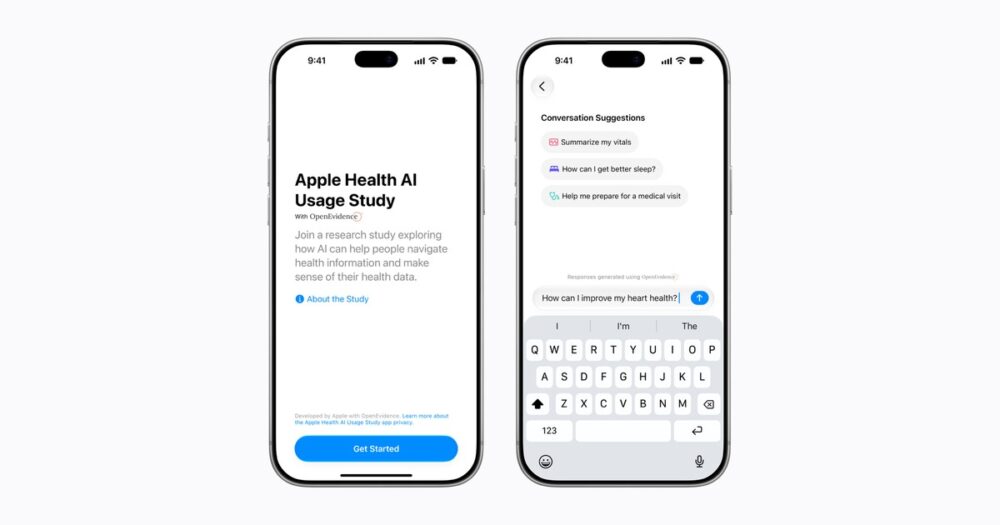
Millions of people already type symptoms into chatbots before they call a doctor. Almost nobody has studied what happens next. Apple now plans to find out, with a research study that could enroll up to 200,000 participants in the United States.
The Apple Health AI Usage Study is a virtual study with its own companion app. Announced November 15, 2026, it examines how people interact with conversational health AI: what makes them trust an answer, how well they understand it, and what they do afterward. Apple says the findings are meant to guide responsible design for its own products and for the wider industry.
What participants will do
The study runs on technology from OpenEvidence, a clinical AI platform widely used by healthcare professionals. Its answers draw on established sources such as The New England Journal of Medicine, JAMA, and Nature. Apple designed the research experience around it.
Inside the app, participants can ask everyday health questions and explore complex medical information written in plain language. Each response links to peer-reviewed clinical citations, so users can see what grounds the answer. That is a notable choice. Many consumer chatbots give fluent answers with little visible sourcing.
Participants can also share HealthKit data, including resting heart rate, activity, sleep, or lab results. The aim is to test whether personal data makes answers more relevant and easier to understand. The study will also look at whether AI can help people prepare for visits with their own doctors.
Why the design matters
Apple acknowledges that consumer tools powered by large language models can give answers that are incomplete or unclear. That candor is useful. The open questions in health AI are less about whether the models can produce correct text and more about how real people read it, trust it, and act on it. A correct answer that a patient misreads is still a failure.
Robert M. Wachter, M.D., chair of the Department of Medicine at UCSF, put the gap plainly. Patients and clinicians are both turning to AI, he said, but the tools are built and tested in separate worlds. If both groups draw on versions of the same trustworthy tools, patients arrive better prepared and conversations improve. Rigorous study of what works, he argued, is how to get there.
Sumbul Desai, M.D., Apple’s vice president of Health and Fitness, framed the project as scientific groundwork. Insights, she said, will help advance the broader scientific conversation.
Privacy and safety
Apple says the study was built with privacy protections, transparency, and clinical guardrails. The most important commitment is that study data will not be used to train AI models. Participants decide whether to share any HealthKit metrics or survey responses, and Apple says it has security measures to protect the data it holds.
The app also includes safety guardrails intended to detect certain concerning questions. When triggered, it suggests the participant follow up with a provider or other resources. Apple describes these as intended to catch some cases, not all, so clinicians should not treat them as a substitute for triage.
Eligibility and availability
Here are the requirements for joining:
- Age 21 or older and living in the United States
- An Apple Intelligence-enabled iPhone, meaning iPhone 15 Pro or later
- iOS 26 or later
- Download of the study app, where people can read about the study and choose to enroll
Enrollment is capped at 200,000 participants.
The bigger picture
This is not a product launch, and no one should expect a finished Apple health chatbot from it. But it signals where Apple is looking. Its health efforts have centered on sensors and alerts. A conversational layer built on cited clinical evidence would be a different kind of offering.
There are caveats. Participants must own recent, expensive iPhones, which skews the sample. Apple has not said when results will appear or whether they will be published in a peer-reviewed journal. Both details will shape how much weight clinicians give the findings.
Still, the scale is rare for research on patient-facing AI, and the questions are the right ones. If the data are shared openly, they could help developers, health systems, and regulators judge what trustworthy health AI looks like in everyday use.