
Huawei has spent years selling watches that estimate your diabetes risk without ever measuring a drop of glucose. The Sense G1 closes that gap. It is the company’s first continuous glucose monitor, and the most notable detail is not the hardware. It is the regulatory status.
China’s National Medical Products Administration has approved the Sense G1 as a Class III medical device. That is the country’s highest risk category, the same one that covers cardiac stents and artificial joints. It is also the first Class III device to come out of Huawei’s consumer hardware business. For a company best known for phones and wearables, that is a serious step.
What the Sense G1 does
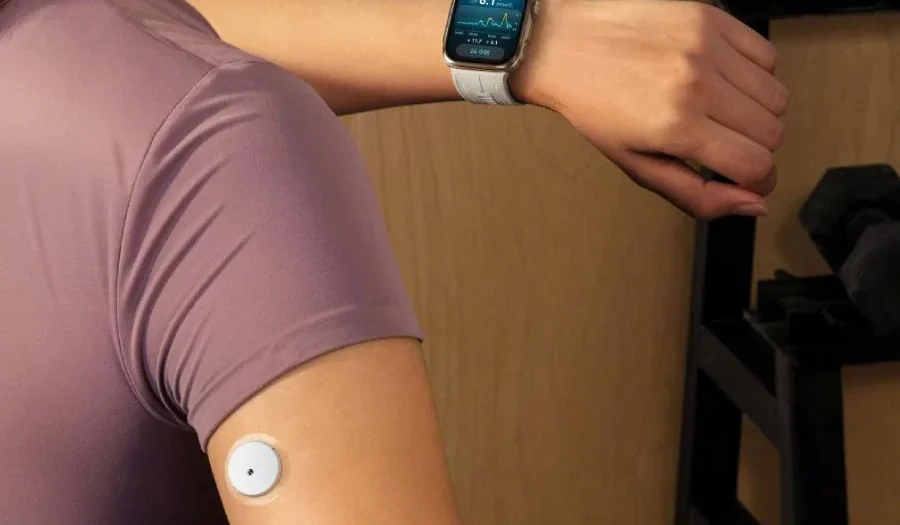
The sensor is a small, round disc that sits on the upper arm. Teaser images have drawn comparisons to an Apple AirTag. A tiny filament sits just under the skin and reads glucose in interstitial fluid, the liquid around cells. The sensor uses glucose oxidase and electrodes to turn that signal into a blood sugar estimate.
There is no finger-prick for each reading. Users can check numbers on a phone or a Huawei smartwatch, and the system can alert them when glucose moves outside a normal range. That alert function matters most overnight, when people with diabetes are at greatest risk of going unnoticed.
Key details so far
- Worn on the arm, designed for a single user
- No calibration required
- Sensor life of up to 16 days
- Out-of-range alerts on phone and watch
- Class III approval from China’s NMPA
Accuracy and lag
Huawei has not published full performance data. A report from a tipster puts the mean absolute relative difference (MARD) below 10%. MARD measures how closely a CGM matches laboratory reference values, and lower is better. Under 10% is generally considered competitive among current commercial sensors, but this figure is unconfirmed, and clinical trial data would give a better picture.
The same source claims readings can trail actual blood glucose by roughly 5 to 15 minutes. That is normal for interstitial sensing, because glucose takes time to move from blood into the surrounding fluid. Clinically it matters during rapid changes, such as after a meal or during exercise. Users and clinicians should treat the number as a trend indicator, not an instant snapshot.
A long road to market
Li Xiaolong, CTO of Huawei Terminal BG, says the Sense G1 is the longest development project the company has run. He first wore a test version in December 2023, which puts testing and development at about 35 months. That is a long time for a consumer electronics firm, and it fits the demands of medical certification.
The device also builds on earlier work. Huawei introduced its TruSense health monitoring system in 2024, and its smartwatches can already assess diabetes risk. But a risk score is not a measurement. The Sense G1 gives that ecosystem a direct glucose input for the first time.
Price, availability and why it matters
Huawei has not announced pricing or a sale date. More details may arrive at an event later this month, where the company is also expected to show the Mate X8 foldable and the MateBook Fold S.
The bigger picture is a familiar one. CGMs are moving out of specialist diabetes care and into mainstream wearables, and large consumer brands are now competing with established medical device makers. Huawei has distribution, a large watch user base, and now a regulatory approval. What it still needs to show is real-world accuracy, sensor wear comfort, and a price that works for patients. Until those arrive, the Sense G1 is a promising entry, not yet a proven one.