

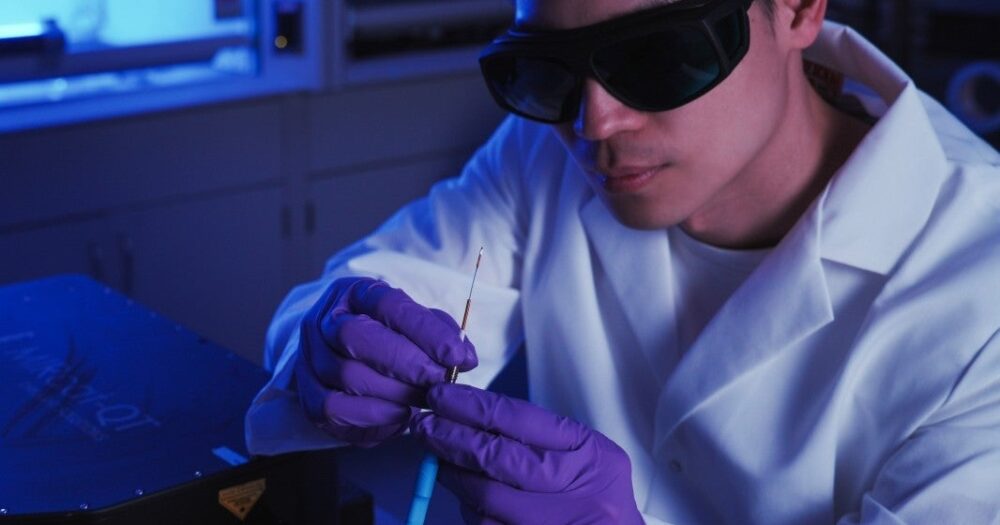
A tiny fiber probe developed at the University of Texas at Austin could change how doctors monitor patients in critical care. The device tracks three vital biomarkers at once – glucose, lactate, and ethanol – in real-time without the delays and invasive procedures current methods require.
At just 1.1 millimeters in diameter, the probe represents a major step forward from traditional monitoring methods that require separate devices for each biomarker and often involve time-consuming lab analysis. This matters because in intensive care units, every second counts when doctors need to make treatment decisions.
Why these three biomarkers matter
The three molecules this probe monitors tell doctors different but equally important things about patient health:
- Glucose levels are critical for diabetes management and general metabolic health
- Lactate can signal dangerous conditions like sepsis or tissue oxygen starvation
- Ethanol monitoring helps treat alcohol poisoning and manage addiction recovery
“Real-time monitoring of biomarkers like glucose, lactate and ethanol is essential for understanding metabolic health and guiding treatment decisions in critical care settings,” said Tanya Hutter, the mechanical engineering professor who led the research published in Nature Communications.
Current monitoring methods fall short
Today’s standard approach, called microdialysis, has significant drawbacks. It requires doctors to collect fluid samples from patients, then send those samples to a lab for analysis. This creates delays that can be dangerous in emergency situations.
The method also disturbs the local tissue environment, which means the results might not accurately reflect what’s happening in the patient’s body. For patients with traumatic brain injuries, for example, doctors insert a probe into the brain to monitor chemical changes, but the lab processing time prevents rapid response to medical emergencies.
“In an intensive care unit where every second counts; they need this information rapidly,” Hutter explained.
How the new probe works
The device uses mid-infrared light to identify and measure molecules directly in tissue. Here’s the process:
- Two silver halide optical fibers sit inside a durable plastic tube with a semi-permeable membrane
- One fiber delivers light and collects the response, while the other acts as a gold-coated mirror
- The membrane prevents direct contact with tissue while allowing molecules to pass through
- A quantum cascade laser provides the specific mid-infrared light needed
Each molecule absorbs light at unique wavelengths, creating distinct signatures that allow the probe to identify and measure concentrations. The probe doesn’t change or react with the molecules – it simply measures how they respond to light.
“Unlike microdialysis, it doesn’t disturb the local tissue environment, so it is more representative of what’s actually happening inside the tissue,” said Tse-Ang Lee, a Ph.D. student who co-authored the research.
From brain injury research to commercial potential
This project received funding from the National Institute on Alcohol Abuse and Alcoholism, but Hutter’s work on biomarker monitoring goes back over a decade. When she was studying at Cambridge University, clinicians approached her about improving care for traumatic brain injury patients.
While the device is designed for hospital use, the technology could eventually be adapted for consumer wellness monitoring in wearable devices. The University of Texas has filed a patent application through its commercialization unit, Discovery to Impact, and is seeking industry partners for licensing.
The research addresses a growing need in healthcare for faster, less invasive monitoring methods that can provide the real-time data doctors need to save lives in critical situations.