
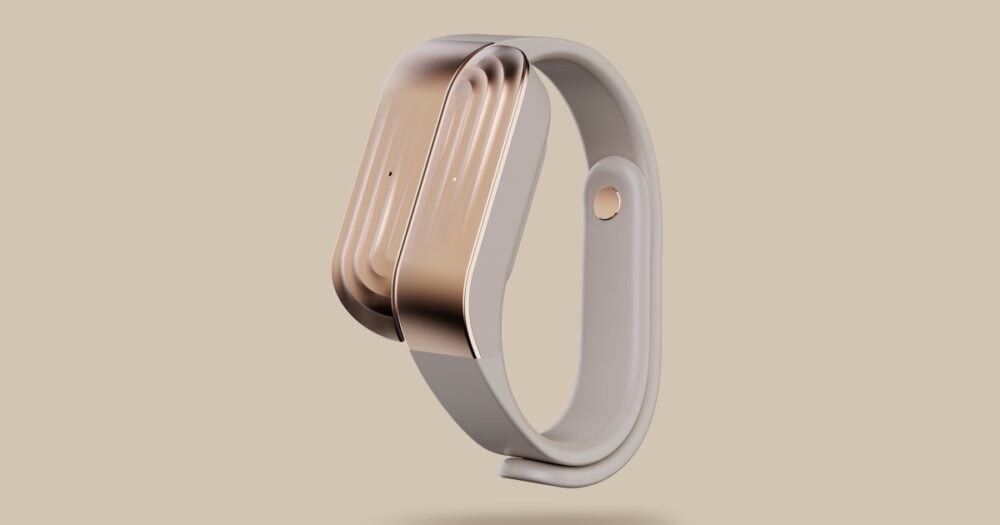
Most health wearables can tell you how well you slept or how many steps you took. What they can’t do is tell you why you feel exhausted, bloated, or off in ways that don’t show up on a step counter. That gap is what Stanford graduates Jenny Duan and Abhinav Agarwal are trying to close with Clair Health, a startup building a wearable device designed to track hormonal health in real time.
The company has raised $11.6 million in a funding round led by Khosla Ventures. Other backers include a16z speedrun, Brydge Club, Treehub, Cartan Capital, AGI House, Insiders VC, Anne Wojcicki, and Stephanie Coleman. The money will go toward getting the device into more hands, building out its AI models, and shipping units to early customers.
Women’s health tech has grown significantly in recent years, but most products still fall into narrow categories: period tracking apps, fertility monitors, or generic fitness wearables. Clair Health is betting there’s a bigger opportunity in continuous, hormone-specific monitoring, something no consumer device has seriously attempted before.
What the device actually does
Clair Health’s wearable has 10 biosensors, including a biomagnetic sensor the company says is key to picking up hormonal signals. That’s a meaningful step up from mainstream smartwatches, which typically rely on a gyroscope, an optical or PPG sensor, and a temperature sensor.
According to Duan, those standard sensors simply weren’t built for hormonal health. “Until today, there hasn’t been a single device, be it invasive or noninvasive, that can capture insights into hormones in real time and get to the source of a problem,” she told TechCrunch. “We didn’t start by thinking of building a particular piece of hardware. We just wanted to track hormones continuously.”
The device monitors users across all four phases of the menstrual cycle, not just around menstruation. Through its sensors and models, Clair surfaces information on:
- Inflammation and bloating markers
- Energy levels
- Cycle phase classification and irregularities
- Perimenopause indicators
- Biological aging pace
- Rate of perceived exertion
Voice-based onboarding and AI analysis
One of the more unusual features of Clair Health is how it collects information from users upfront. Rather than asking people to fill out forms or tap through menus, the app uses a voice-based onboarding process to learn about a user’s health history and symptoms.
The startup says it has also trained its own AI to analyze voice biomarkers and determine which phase of the menstrual cycle a user is in after just a few minutes of conversation. The idea is that speech patterns carry physiological signals that can tell the system something meaningful about where someone is in their cycle.
Duan explained the thinking behind this approach: “What we found is that in women’s health and in the current state of apps, women can’t communicate a large amount of symptoms because the apps are built for only specific ones. With our voice stack, we are giving our users a way to communicate their own problems in their own way.”
A data strategy built on health records
Getting hormonal health insights right requires a lot of data, and Clair Health is trying to build that foundation through partnerships that give it access to several million electronic health records and longitudinal health data.
The company says it’s using that data to build models that can eventually provide insights into conditions including:
- Endometriosis
- PMDD (premenstrual dysphoric disorder)
- Perimenopause
The clinical angle is also a selling point for the company’s investor base. Mary Minno of Treehub, a Stanford-adjacent residency backed by the AI Health Fund, put it plainly: “Hormonal health measurement today is still archaic. My perimenopausal friends are still getting blood draws to understand the efficacy of hormone treatments. Out of the gate, Clair aims to deliver a product that shines a light on what previously required a blood draw.”
How Clair compares to what’s already out there
Clair Health isn’t the only company working on this problem, but its approach is distinct. The broader space includes:
- Level Zero Health, which tracks hormonal markers through a continuous glucose monitor-style device
- Hormona, which relies on at-home test kits
- Ourself Health, an app that uses AI to generate insights based on symptoms users log manually
What sets Clair apart, at least on paper, is continuous passive monitoring through a wearable rather than periodic tests or manual input. Whether the biosensors deliver on that promise is the question the company’s beta testing phase will need to answer.
Pricing, availability, and what’s next
Clair Health is currently testing its device with a closed group of beta users. It plans to ship units in November at a price of $369, paired with a $9.99 monthly subscription. Preorders are open now.
Duan’s path to this company started when she worked at a nonprofit in Portland during her school years, where she first got interested in women’s health. She later took a women’s health-focused course at Stanford, where she met Agarwal. The two have since built Clair Health around the idea that women deserve hardware that was actually designed around their biology, not adapted from tools built with someone else in mind.