
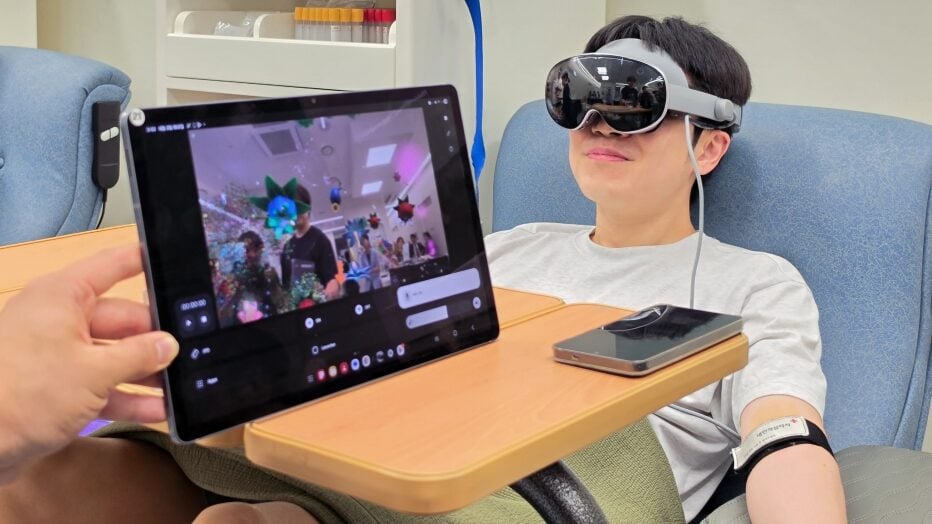
Giving blood is not a painful process, but it can be an anxious one. You sit still for several minutes with a needle in your arm, staring at the ceiling, trying not to think about what’s happening. Samsung and healthcare company Abbott think extended reality headsets can fix that, and they’ve already run their first test in South Korea to prove it.
On June 2, Samsung and Abbott teamed up with the Korean Red Cross to run the country’s first XR-powered blood donation campaign at Samsung Digital City in Suwon. The timing was deliberate: the event was held in recognition of World Blood Donor Day, which falls on June 14 each year. Samsung employees donated blood while wearing Galaxy XR headsets, with Korean Red Cross staff present throughout.
The program is now set to expand to events in the United States and Malaysia. That matters because blood donation rates have been a persistent public health concern in many countries, and anything that reduces anxiety around the process could help bring in more donors. This is a small but practical test of whether consumer XR hardware has a role to play in healthcare settings.
What donors actually experience
The headset experience is simple by design. Once a donor puts on the Galaxy XR, they enter a Zen garden environment. There are no controllers and no hand gestures required. Donors interact entirely through their gaze, planting virtual flower seeds just by looking at them. Over three to five minutes, flowers and trees grow around them while music composed with the Chicago Symphony Orchestra plays in the background.
Two Samsung employees who donated during the campaign described the experience in straightforward terms:
- Geunwoo Park from the Networks Business said donating blood can feel boring because you have to sit still, and found the headset made it more enjoyable.
- Gangsu Kim from the Visual Display Business, making his 20th blood donation, said he found the gaze-based interaction especially interesting because the content responded directly to where he was looking.
The gaze-only interaction is not just a design choice for comfort. It also means donors keep their arms still, which matters medically during donation.
Why Abbott and Samsung are working together on this
Abbott’s involvement comes through its Transfusion Medicine division, which has been running XR-enhanced blood donation campaigns with Red Cross organizations since 2016. Those campaigns have reached nearly 30 countries. The Galaxy XR headset is the latest hardware the company has incorporated into that program.
Miguel Carrazza from Abbott’s Transfusion Medicine division said the Galaxy XR is well-suited for healthcare settings because medical staff can still monitor donors easily while they wear it. That’s a real practical requirement. A headset that completely blocks a nurse’s view of a patient’s face or arm would be a non-starter in this context.
James Pak, VP of Samsung’s Global Mobile B2B Team, framed the initiative as evidence that Galaxy XR has uses beyond entertainment and productivity. Samsung launched Galaxy XR in late 2025, and the company has been actively building out enterprise and healthcare use cases to justify the hardware’s existence in professional settings.
Where the program is heading next
Two major events are coming up in June 2026 where the XR blood donation program will be on show:
- Augmented World Expo (AWE) in Long Beach, California, running June 15-18. Samsung and Abbott will host a four-day blood drive at the event, targeting attendees from across the XR industry.
- International Society of Blood Transfusion (ISBT) Congress in Kuala Lumpur, Malaysia, later in June. More than 100 blood bank decision-makers from around the world will be able to see the program in action.
The ISBT appearance is the more strategically significant of the two. Getting blood bank operators and healthcare decision-makers to experience the technology firsthand is the fastest way to expand the program beyond Samsung employees and conference attendees. If blood banks in other countries adopt it, the reach grows quickly.