

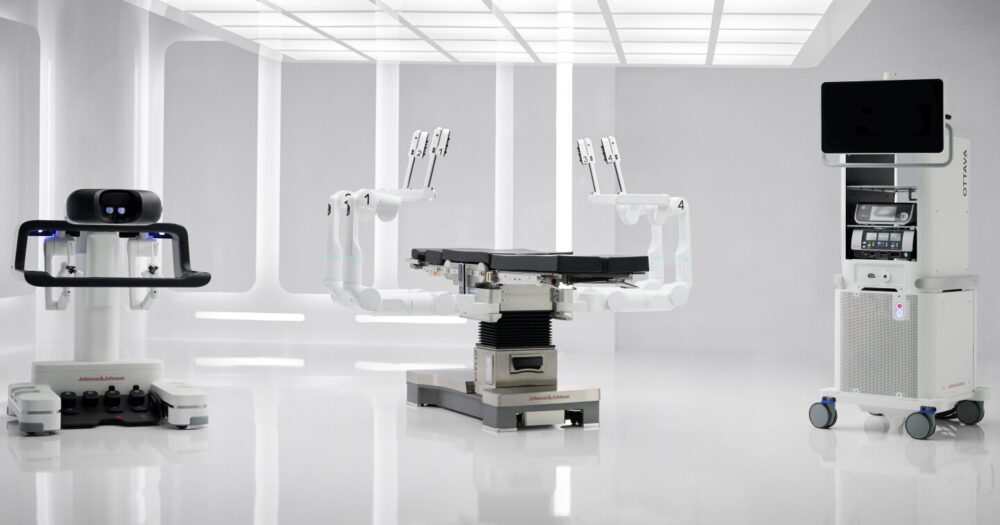
Robotic surgery has a space problem. Most systems require a large cart or boom that crowds the operating room, limits team movement, and slows turnover. Johnson & Johnson’s new OTTAVA system takes a different architectural approach: the robotic arms are built directly into the OR table. On July 22, the FDA granted De Novo authorization for the system, clearing it for ten general surgery procedures in the upper abdomen.
What it’s cleared for
The approved indications cover a broad range of upper abdominal procedures, including Roux-en-Y gastric bypass, gastrectomy, cholecystectomy, splenectomy, gastric sleeve, small bowel resection, appendectomy, lysis of adhesions, fundoplication, and hiatal hernia repair. A clinical trial for inguinal hernia is ongoing.
How the system works
OTTAVA’s table-integrated design occupies 30 to 50% less floor space than traditional cart-mounted systems. The four robotic arms move in coordination with the table itself, allowing patient repositioning and multi-quadrant access without stopping to manually adjust instruments. J&J calls this “twin motion.” The instrumentation has also been redesigned, with a two-in-one needle driver intended to reduce unintended suture cutting and monopolar curved scissors built for more consistent cuts.
- Table-integrated arms with synchronized table and arm motion
- Automated procedural poses to simplify OR setup and breakdown
- Redesigned instrument portfolio based on open and laparoscopic surgery experience
- Polyphonic digital ecosystem for data, media, and surgical learning
- Training programs developed with clinicians and surgical societies
Why this matters beyond the clearance
Surgical robotics adoption has been constrained by OR throughput and high system costs. If OTTAVA’s smaller footprint and automated setup genuinely reduce room turnover time, that’s a real economic argument for hospital administrators. Still, De Novo clearance is just the starting line. J&J plans a selective U.S. launch with early customers before scaling, which is a sensible approach for a first-generation system entering a market already shaped by Intuitive Surgical’s dominance.
Learn more about the system at ottava.jnjmedtech.com.