
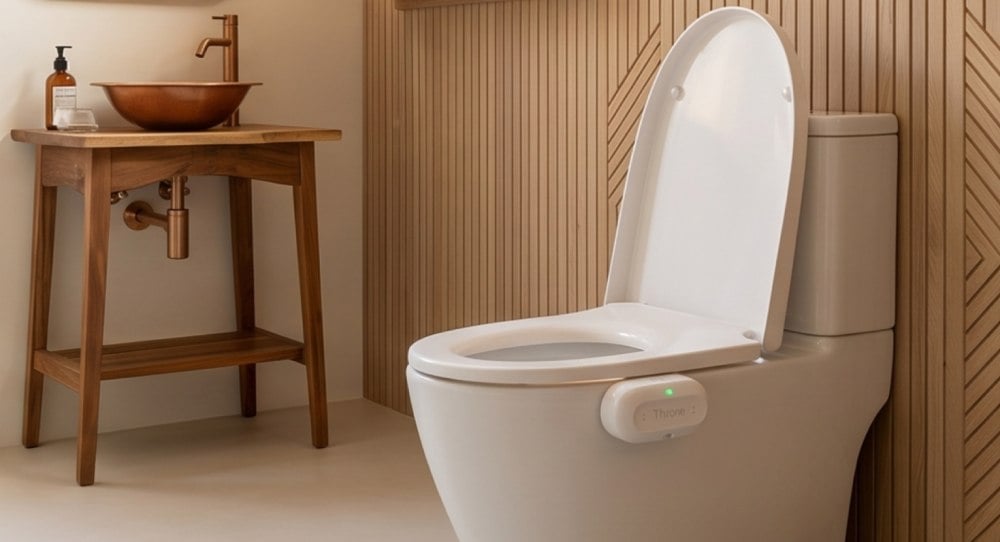
Most people track their sleep, their steps, and their heart rate. Almost nobody tracks what happens in the bathroom. Throne Science thinks that’s a significant gap in how we understand our own health, and it just raised $10 million to prove the point.
The Austin-based company, founded in 2023 and launched to consumers in March 2026, has closed a Series A round led by Will Ventures, with participation from Emerson Collective, Felix Capital, Accomplice, Moxxie, and a range of other investors. The funding will go toward team growth, R&D, and the next generation of the device itself.
What the device actually does
Throne’s sensor attaches to any standard toilet and uses computer vision and AI to monitor bathroom habits passively, with every flush. It tracks patterns in gut health, hydration, and urinary function over time, then surfaces that data through a companion app in plain language rather than clinical readings. In July, the company launched a beta version of a Gut Health AI coach that lets users ask questions about their own data and receive personalized feedback.
The pitch is simple: passive, continuous data from a part of daily life that has historically produced no data at all. For the estimated 25 to 45 million Americans living with conditions like irritable bowel syndrome, that kind of longitudinal pattern recognition could be genuinely useful. And that’s before considering the long-term ambition.
The bigger clinical bet: colorectal cancer screening
Throne’s founders are explicit about where they want the technology to go. Colorectal cancer is the second deadliest cancer in the United States, and current screening relies on colonoscopies, stool tests, and other methods that require deliberate action from patients. Throne is positioning its next device iteration as a potential at-home, continuous early detector for colorectal cancer and cancers of the urinary tract.
That’s an ambitious target, and the company is building its advisory bench accordingly. Recent additions include Dr. Fola May, a gastroenterologist focused on chronic disease outcomes, and Dr. Aasma Shaukat, a global leader in colorectal cancer prevention. The scientific team also includes Dr. Karan Rajan, a surgeon with a substantial public following in gastrointestinal health, who joins as Chief of Science.
The R&D hire is also notable. David Strasfeld, PhD, joins as SVP of R&D from Lumicell, a company working on cancer visualization during surgery. Ben Grynol, formerly Head of Growth at Levels Health, joins as VP of Growth. John Capodilupo, co-founder of Throne, was previously CTO at WHOOP.
A market that’s already moving
Consumer interest in gut health has grown sharply in recent years, driven by expanding awareness of the gut microbiome’s role in broader health outcomes. The global gut health market is projected to reach $105.7 billion by 2029. Throne is entering that market with a hardware-first approach at a moment when most competitors are selling supplements or food products.
Ben Gardner, Managing Partner at Will Ventures, framed the investment around data defensibility. “Gut health is the new frontier,” he said. “We’re talking about one of the richest sources of health data available, and yet we have no way to track and optimize our gut health habits today.”
So the core question isn’t whether the gut health market is real. It is. The question is whether a toilet sensor can produce data that’s clinically meaningful enough to change outcomes, and whether consumers will trust and consistently use a device in that particular context. Throne’s next phase of R&D will have to answer both.