
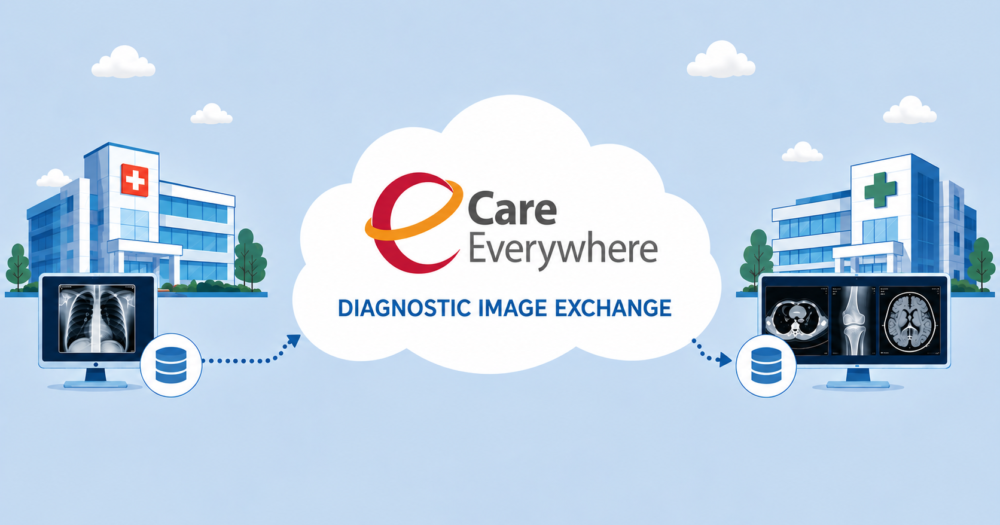
Millions of Americans still walk into specialist appointments carrying a CD with their imaging on it. That’s not a technology failure from a decade ago. That’s today. And it’s one of the more absurd friction points in modern healthcare, one that Epic is now directly targeting with the release of Care Everywhere Diagnostic Image Exchange.
Launched in August 2026, the feature allows health systems running Epic to retrieve diagnostic-quality images, including CTs, MRIs, and X-rays, from other organizations’ image archiving systems with a single click. No phone calls, no faxes, no discs handed across a reception desk.
What’s actually changing, and why it was hard before
To understand why this matters, you need to know what existed before. Epic’s Care Everywhere network has long supported the sharing of written radiology reports and lower-resolution reference-quality images. These are useful for context, but they lack the detail required for clinical decision-making. The full diagnostic image lives in a separate system, called a PACS (picture archiving and communication system), and getting it transferred between institutions has historically involved manual workflows and proprietary formats with no common standards.
That’s the core problem Epic is solving. By building on open image exchange standards and routing through its existing interoperability infrastructure, Care Everywhere can now move diagnostic-quality images between health systems’ archiving systems directly. Clinicians identify the image they need from the reference version, then retrieve the full file in one step.
The clinical case for faster image access
The duplicate scan problem is real and measurable. Patients sometimes undergo imaging they’ve already had elsewhere simply because their current clinician has no visibility into prior studies. Epic’s existing duplicate-order checks already flag these cases across organizations, preventing more than 21,000 repeat scans per year. But flagging a duplicate is only half the solution. Without access to the actual image, a clinician may still need to repeat the scan or delay treatment while chasing records. Diagnostic Image Exchange closes that gap by making the prior image retrievable, not just identifiable.
The clinical benefit is straightforward: faster diagnosis, earlier treatment, and reduced radiation exposure for patients who would otherwise undergo repeat imaging.
Standards and the bigger interoperability picture
Epic is positioning this as more than a product feature. Matt Doyle, Epic’s director of interoperability, described the release as the first adoption of open image-sharing standards at scale, and the company is actively advocating for TEFCA, the federally sponsored interoperability framework, to incorporate these standards so that image exchange becomes possible across all US health systems, not just those on Epic.
That’s a meaningful policy stance. TEFCA has made real progress on structured clinical data exchange, but imaging has largely been left out. If open image standards get incorporated into TEFCA’s framework, the infrastructure Epic is building now could become part of a much broader national exchange.
Availability and what health systems need to do
Care Everywhere Diagnostic Image Exchange is available now across the Epic community. Health systems that already use Epic and have connected PACS infrastructure are positioned to take advantage of it. The feature requires no new interoperability agreements to be negotiated from scratch, because it runs through existing Care Everywhere pipelines.
For patients, the change should be largely invisible, which is exactly the point. The goal is that they simply stop being asked to carry their own imaging records from appointment to appointment.
- Supports diagnostic-quality CTs, MRIs, X-rays, and other modalities
- Single-click retrieval from external image archiving systems
- Built on open image exchange standards
- Integrates with Epic’s existing duplicate-order detection tools
- Available across the Epic community as of August 2026
Image exchange has been a stubborn gap in health data interoperability for years. This release won’t fix every edge case, but it addresses the most common and most frustrating one. And it does so in a way that pushes the broader industry toward open standards rather than proprietary workarounds.