

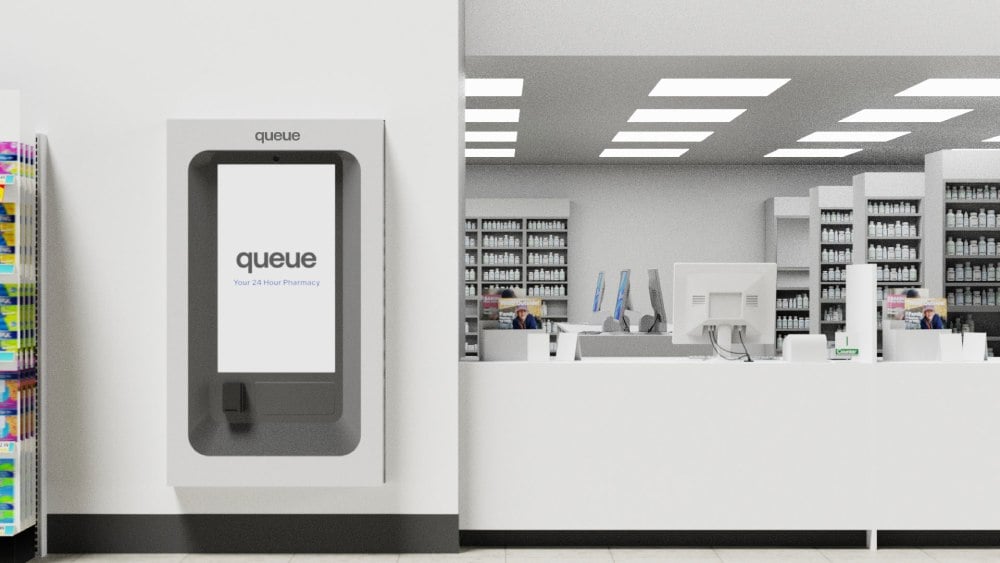
Nearly one in three U.S. pharmacies has closed since 2010. Technician vacancy rates are running above 40%. And pharmacy schools are producing thousands fewer graduates than the industry needs. Into that gap steps Queue, a Palo Alto startup that just closed a $12.6 million seed round to commercialize what it says is the first fully autonomous robotic pharmacy system.
How the system works
The concept is straightforward: sealed wholesale pill bottles go in one end, filled and verified prescription vials come out the other. No on-site pharmacist required. The platform currently covers 250 of the most commonly prescribed medications in the U.S., and Queue says it can reduce fulfillment costs by up to 96% compared to traditional pharmacy operations.
Queue emerged from stealth with a working prototype already deployed with an undisclosed national pharmacy chain, giving it early commercial validation before the seed round even closed.
Who’s backing it
The $12.6 million seed was led by AlleyCorp and was oversubscribed. It follows a $6 million pre-seed from Riot Ventures less than a year ago, bringing total funding to $18.6 million. House Capital, Ubiquity Ventures, Grep Ventures, and Banter Capital also participated.
AlleyCorp General Partner Abe Murray called Queue “critical infrastructure” for patient access. Riot Ventures Partner Will Coffield pointed to the founders’ decision to automate the physical fulfillment layer itself, rather than work around the industry’s structural problems.
The team behind it
Queue was co-founded by Nick Desai, CEO, who previously built Heal, a home healthcare company that raised over $200 million, and Josh Liu, CTO, whose background spans Tesla and Zipline. The company has 20 engineers in Silicon Valley and is hiring across robotics, hardware, software, and pharmacy operations.
Why this matters clinically
The workforce math alone makes automation compelling. But the access angle may be more significant. Queue says its system can be deployed in retail locations, hospitals, and rural communities, precisely the settings where pharmacy deserts are deepest. So the question isn’t whether autonomous dispensing is coming. It’s whether the regulatory and safety frameworks will keep pace.