
Apple claims the heart rate sensing in its new Watch Series 12 and Ultra 4 is the most accurate of any wearable on the market. That’s not just marketing copy — it’s backed by a study of over 1,000 participants across diverse demographic groups, benchmarked against competing devices. In a category where data quality determines clinical usefulness, that matters.
A new sensing system underneath the hood
The hardware upgrade centers on a redesigned Health Sensing System with new optical and electrical heart sensors. Larger, power-efficient green LEDs now capture heart rate every five seconds, continuously, throughout the day. Heart rate variability (HRV) is measured as often as every five minutes — 24 times more frequently than before. Apple provides two HRV variants: Recovery HRV for daily stress and recovery signals, and overall HRV for broader cardiovascular context. Both are now visible in an updated Heart Rate app, and Recovery HRV is included in the Vitals overview alongside a new daytime vitals view.
Readiness: a single number to start the day
The headline feature is readiness, a 0-to-10 daily score that synthesizes recent activity, vitals, and sleep data into one of four plain-language recommendations: Recover, Pace Yourself, Ready, or Go For It. The algorithm was developed using data from the Apple Heart and Movement Study, in collaboration with exercise scientists and physicians. The score updates throughout the day as new data arrives, and users can see exactly which factors are driving it. That transparency is important. A black-box wellness score has limited value. This one shows its working.
The Health app gets an AI overhaul
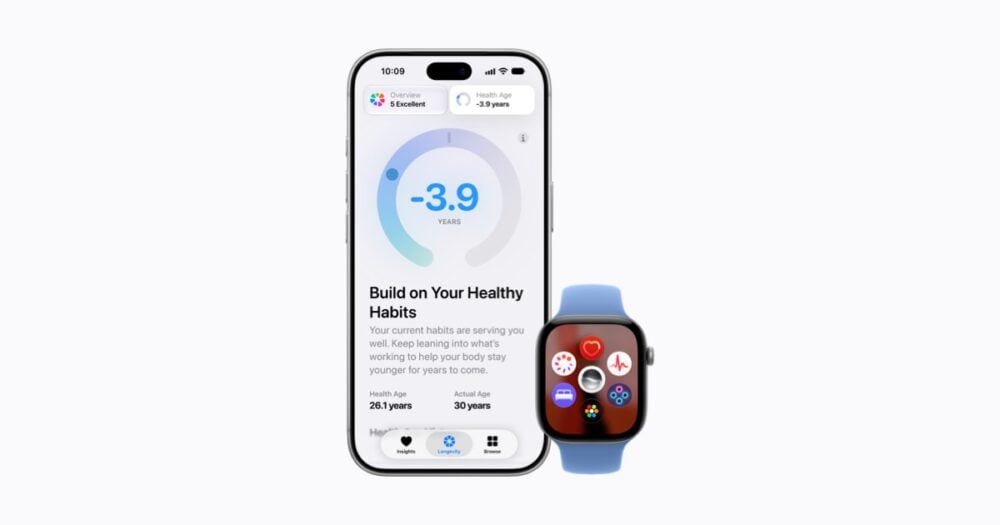
Coming later this year with iOS 27, the redesigned Health app uses Apple Intelligence to do something the current version doesn’t: connect the dots across datasets over time. A new Insights tab surfaces personalized daily summaries across heart, sleep, readiness, fitness, vitals, and cycle tracking. A new Longevity tab analyzes longitudinal data across heart health, sleep, mental wellbeing, movement, metabolic health, and hearing.
- Daily Insights tab with summaries that update throughout the day
- Personalized “For You” recommendations based on individual health patterns
- Longevity tab covering seven health domains with long-term trend analysis
- All data processed with on-device privacy protections
For clinicians, the practical question is whether patients will act on these insights. Apple is betting that clearer, more personalized presentation will close the gap between data collection and behavior change. It’s a reasonable bet — and one the broader health tech industry is watching closely.