
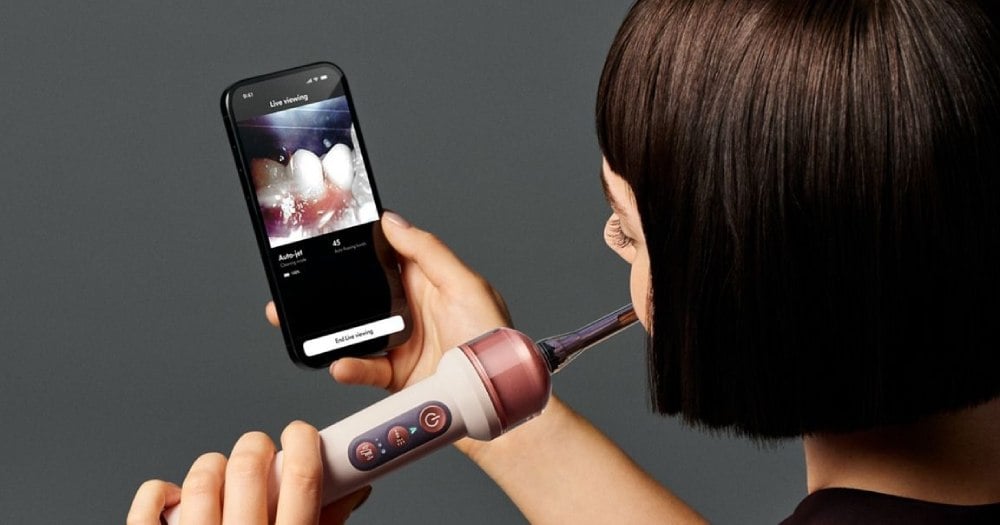
Nine in ten people don’t floss regularly. Most spend 45 seconds brushing when dentists recommend two minutes. And nearly everyone misses the same spots: the gaps between teeth, where plaque forms first. Dyson thinks it has built a fix.
At an event in Paris, James Dyson revealed the Dyson CameraJet, a toothbrush with an integrated 100,000-pixel macro lens camera that scans 28 frames per second, identifies gaps between teeth in real time, and fires a precision jet of mouthrinse into those gaps within 100 milliseconds of detection. The AI system behind it, called Gap Optical Targeting, was trained on 470,000 dental images and runs on 16 million lines of code.
That’s a lot of engineering for something most people do half-awake in the morning. But the clinical rationale is real. The WHO’s 2025 Global Oral Health Status Report estimates 3.7 billion people are affected by oral disease globally, and poor oral health is increasingly linked to systemic conditions including heart disease and Alzheimer’s.
Why the jet shape matters
Dyson’s fluid dynamicists tested conventional water flossers, which typically use a narrow, needle-type stream, and found they pierce through plaque without fully removing it. The CameraJet uses a broader conical spray designed to sweep plaque away at lower pressure, which Dyson says is gentler on gums and enamel. Plaque testing was done using a proxy plaque material developed over five years with the National University of Singapore’s Faculty of Dentistry.
Hardware built around real habits
The device also addresses some practical frustrations with existing oral care tech. A 12.5ml anti-gravity tank uses a diaphragm pump and pressure chamber to deliver consistent jets regardless of the angle, including horizontal, which matters when brushing the back of the mouth. A docking station refills the tank in three seconds and charges the device between uses.
- Dual-bristle head with firmer inner bristles for stain removal and softer outer bristles for gumline cleaning
- Variable sonic oscillation to prevent bristle stalling in hard-to-reach areas, removing up to 69% more plaque than leading premium electric toothbrushes in those zones
- RFID-tagged brush heads that track usage and alert users when replacement is due
- Travel case included for use outside the home
What this means for oral care
The CameraJet doesn’t replace a dentist. But if it gets more people actually cleaning between their teeth, consistently, that has real public health value. The bigger question is whether patients will use it correctly over time, and whether clinical trials will confirm the plaque removal claims at scale. Dyson says external testing supports the bristle performance data. Independent validation of the camera-guided jetting will be worth watching.