
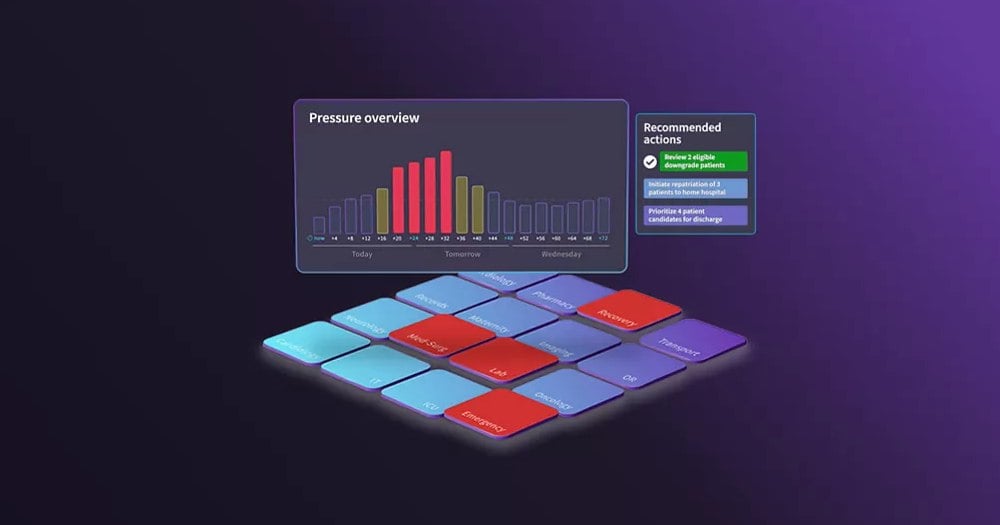
Hospital operations teams are often the last to know that a crisis is coming. By the time a capacity crunch becomes visible, care teams are already scrambling. GE HealthCare is betting that a 72-hour predictive window can change that, and its new AI-powered platform, CareIntellect for Operations, is designed to do exactly that.
Announced on September 15, 2026, CareIntellect for Operations is a cloud-based Software-as-a-Service application that analyzes hundreds of real-time and historical data points, including bed availability, staffing levels, emergency department wait times, boarding delays, inbound transfers, and ancillary service capacity. From that data, it generates forward-looking forecasts at the unit, department, and enterprise level, and recommends specific actions for operational leaders to take before problems compound.
The Queen’s Health Systems in Hawaii and Duke Health in North Carolina will be the first to implement the platform, providing clinical and operational feedback that GE HealthCare says will shape future development.
Why this matters now
The timing is not arbitrary. U.S. inpatient volumes rose 5.3% in 2025, according to the American Hospital Association, pushing many systems to or beyond their operational limits. At the same time, staffing shortages and rising costs have narrowed the margin for error. Many operational leaders still spend several hours each day manually pulling data from disconnected systems, with little ability to anticipate what’s coming next. Some teams still track operational updates by hand.
That kind of reactive management has a real cost. Delays in discharge, inefficient bed turnover, and uncoordinated transfers don’t just strain staff. They limit how many patients a system can actually serve.
What the AI actually does
CareIntellect for Operations runs two proprietary AI models. The first, the Pressure Forecast model, draws on historical operations data and live feeds from the electronic medical record and resource management systems to project capacity constraints up to three days out. The second, the Estimated Day of Discharge model, predicts when individual patients are likely to leave, updating its estimates hourly as new clinical information arrives.
Together, these models surface prioritized workflow recommendations, not just alerts. The intent is to move teams from spotting a problem to knowing what to do about it, faster.
Built on two decades of hospital operations data
GE HealthCare’s Command Center software, which is used by nearly 500 hospitals globally, provides much of the operational knowledge base behind this product. Command Center customers have reported outcomes including up to $20 million in first-year cost savings, a reduction in length of stay of more than one day, and enough freed capacity to treat 19,000 additional patients annually at one health system.
CareIntellect for Operations is built on Amazon Web Services and is available through both GE HealthCare directly and the AWS Marketplace. It sits within GE HealthCare’s broader CareIntellect family of applications, which share a common cloud infrastructure so hospitals can add new applications without the cost and time of repeated one-off integrations.
What early adopters are expecting
Duke Health’s Katie Flanagan, Associate Vice President of Patient Flow and Care Coordination, described the platform as building on three years of existing partnership with GE HealthCare. The goal, she said, is to give teams a three-day view of what is coming so they can move faster from analysis to action.
At Queen’s, Chief Operating Officer Alex Wroe framed the value in terms of access. Predicting capacity pressure in advance means more beds, staff, and resources are available when patients actually need them, rather than being locked up by inefficiencies that could have been resolved earlier.
The bigger picture
AI in hospital operations is not new. But most tools have focused on dashboards and retrospective reporting. A platform that connects forecasting directly to recommended actions, and updates those recommendations in real time, is a more clinically relevant proposition.
Still, predictions are only as useful as the workflows built around them. The real test will come from how frontline teams at Queen’s and Duke Health actually integrate these recommendations into daily operations, and whether the forecasts hold up under the unpredictable conditions of real hospital environments. GE HealthCare says it has invested more than $5.1 billion in innovation since 2023. CareIntellect for Operations is one of the clearest signals yet of where that investment is headed.