

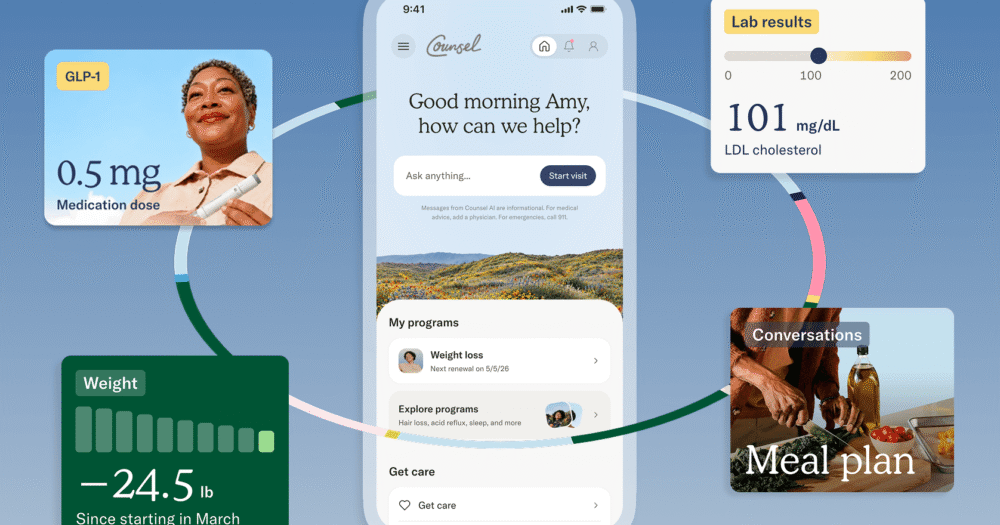
Most people who start a GLP-1 drug stop taking it. Only 32% remain on therapy at the end of year one, and just 15% by year two. Counsel Health thinks the missing piece is continuous medical support, and it just built a program around that idea.
The New York company, which describes itself as AI-native primary care, announced a weight management program on October 27, 2026. It is available directly through Counsel and through LillyDirect, Eli Lilly’s direct-to-consumer digital pharmacy.
Why the timing matters
GLP-1 use is climbing fast. About 11% of U.S. adults now take these drugs for weight loss, up from 3% in 2024. More patients means more questions about side effects, dosing, and progress, often with little follow-up once the prescription is written.
What members get
Members can reach board-certified physicians on demand, typically within minutes. The membership also covers primary care, including urgent concerns and related conditions such as hypertension, diabetes, and high cholesterol. That bundling makes clinical sense, since obesity rarely travels alone.
Counsel says its AI-supported model keeps costs below traditional weight management programs. Pricing comes as an annual membership or a pay-as-you-go option. The company’s medical AI is free to use and routes people to a physician when needed.
“GLP-1s are powerful medications, but a prescription alone is not a care model,” said Dr. Muthu Alagappan, Counsel’s founder and CEO.
The LillyDirect connection
Through LillyDirect, Counsel is one of the listed providers. Eligible consumers who choose it receive a physician-led evaluation, a GLP-1 prescription when clinically appropriate, and ongoing support. The program is available in the 44 states where Counsel’s consumer platform operates.
What to watch
The announcement offers no outcome data. Whether this model improves the 32% retention figure is the real question, and Counsel has not yet shown that it does. Still, the pitch is sound: pair access to a drug with access to a doctor. If it works at a lower price, it could pressure telehealth competitors that treat the prescription as the endpoint.
More information is available at counselhealth.com.