
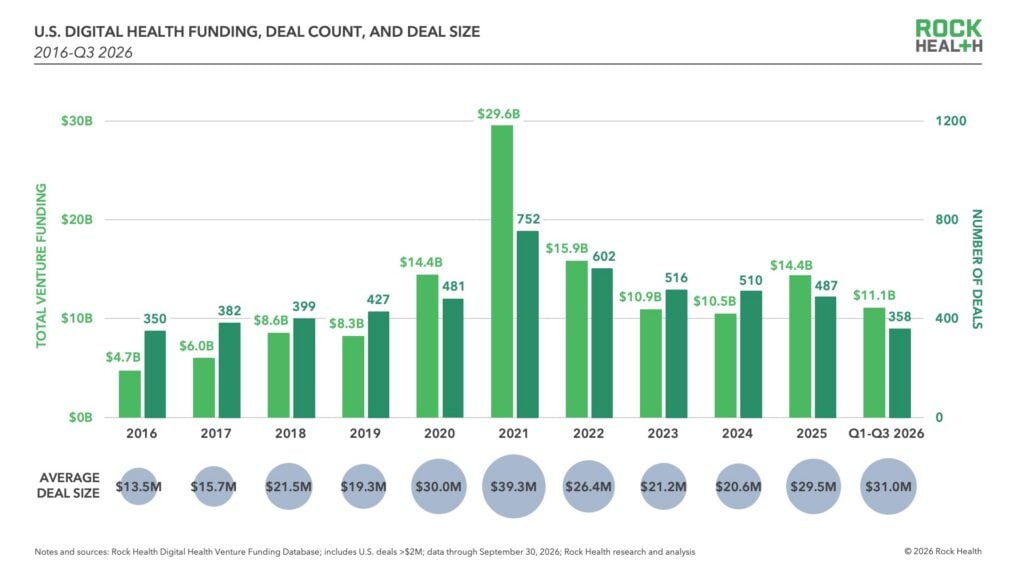
In August 2011, Rock Health counted just 35 U.S.-based venture-backed digital health companies. This year, funding is on pace to exceed $14.8 billion. That’s not a typo. It’s the distance the sector has traveled in fifteen years, and it’s the backdrop for Rock Health’s latest market update, which doubles as a retrospective on what the organization calls the ‘crystal anniversary’ of digital health.
The crystal metaphor is deliberate. Clarity, transparency, strength of a mature relationship. After a decade and a half of building, losing, pivoting, and occasionally getting it right, Rock Health is asking: what do we actually know now?
Where the money went in Q3 2026
Before the reflection, the numbers. U.S.-based digital health startups raised $3.7 billion across 114 deals in Q3 2026, bringing the year-to-date total to $11.1 billion across 358 deals. Capital is concentrating. The average deal size climbed to $31.0 million in 2026, up from $29.5 million in 2025 and $20.6 million in 2024. Fewer deals, bigger checks. That pattern has held across all three quarters this year.
On the exit side, M&A activity has kept pace with 2025, which was the strongest year since 2021. Q3 logged 45 digital health acquisitions, bringing the 2026 year-to-date total to 164, roughly in line with 172 through Q3 last year. The public markets remain quiet. No new listings have appeared since HeartFlow in August 2025, though reports of at least one postponed debut suggest the window isn’t permanently closed.
What 2011 actually looked like
The early digital health market was not the sophisticated ecosystem it’s sometimes romanticized as. Healthcare funds were trying to understand technology. Technology funds were trying to understand healthcare. Founders had to defend the category itself before they could pitch their own companies. Only 2% of early-stage digital health entrepreneurs surveyed in 2011 reported securing venture funding. The remaining 84% were bootstrapped.
Michael Greeley, Co-Founder and General Partner of Flare Capital Partners, described the investment climate as the ‘Wild West.’ Sean Duffy, Co-Founder and CEO of Omada Health, recalls noticing limited convergence between healthcare and technology at the time, with few accelerators and little talent oriented around the category. Rock Health’s own founder, Halle Tecco, remembers having to make the case that technology entrepreneurs could have any role in healthcare at all. Still, optimism ran high. Seventy-seven percent of VCs surveyed in 2010 expected healthcare IT investment to increase. That prediction held, and then some.
From digitizing forms to removing friction
The first wave of digital health innovation largely took healthcare as it existed and put it on a screen. Chris O’Dell, President of Turquoise, recalls when ‘e-visits’ and the ‘digital front door’ were considered bold ideas. Nickolas Mark, Co-Founder and Managing Partner of Intermountain Ventures, describes those early efforts as ‘digitizing forms, and not the workflows around them.’
What changed, gradually, was the sector’s willingness to ask harder questions about what should actually be made digital. O’Dell points to early missteps in automating parts of healthcare that patients and clinicians valued most, including the physician-patient relationship. But over time, the focus shifted. The sector moved toward what Mark calls ‘addition by subtraction’: removing unnecessary steps, reducing cognitive load, targeting administrative waste rather than clinical presence.
Electronic prior authorization replaced phone calls and faxes, at least partially. Ambient documentation tools made it easier for clinicians to capture notes without breaking eye contact with their patients. These are not flashy applications. But they reflect a more mature understanding of where technology actually helps.
What fifteen years of data actually shows
The aggregate numbers are striking:
- Over $140 billion raised across the sector since 2011
- Nearly half of American adults now own a wearable device
- More than 3,200 venture-backed digital health companies have raised $2 million or more
- Rock Health has supported 200-plus healthcare enterprise partnerships
- 2026 funding pace implies roughly 12 times the capital deployed compared to 2011
But the honest read of this retrospective is that capital and adoption, while necessary, haven’t been sufficient. Many of digital health’s earliest ambitions, truly integrated care, equitable access, meaningful outcomes at scale, remain works in progress. The sector has matured enough to know that. And that self-awareness may be the most important development of all.
Rock Health’s 15th annual Summit marks a moment worth pausing on. Not because everything has been figured out, but because fifteen years of consistent data and hard-won experience now exist to inform what comes next.