
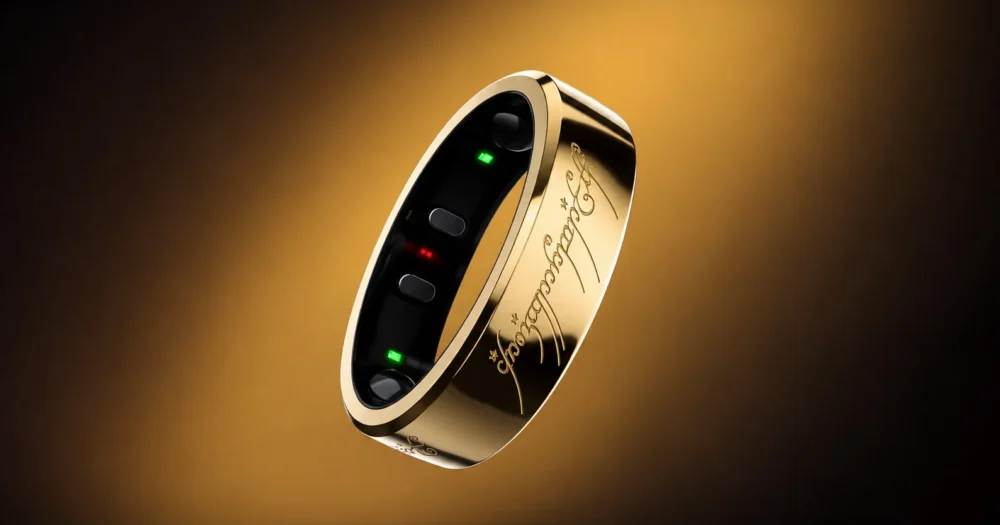
The most interesting thing about RingConn’s new Lord of the Rings ring is what it doesn’t change. The One Ring, made in partnership with Warner Bros., wraps the company’s Gen 3 health tracker in laser-engraved Elvish script. Inside, it’s the same device that launched earlier this year.
The price is $399, a modest step above the standard Gen 3. For that premium you get the engraved titanium band, a themed unboxing experience with a custom sizing kit, and an exclusive Middle-earth skin for the companion app. Pre-orders opened on November 19 in select markets across North America, EMEA and the Asia Pacific region.
So the real question is whether the underlying ring is any good. On paper, it is a capable one. The titanium shell is 2.3mm thick and weighs between 2.5 and 3.5 grams depending on size. The interior is lined with medical-grade epoxy resin and holds sensors for heart rate, skin temperature and motion. It is also rated 10ATM for water resistance, so swimming and showering are fine.
A built-in vibration motor is the feature most worth noting. The ring buzzes your finger when it detects high stress, prolonged inactivity or a low battery. That matters for a practical reason. Wearables only help if people act on what they show, and a nudge on the hand is harder to ignore than a notification buried in a phone. Whether those alerts change behavior over months is still an open question, but the design logic is sound.
On the software side, the ring covers a broad set of metrics. These include:
- Overnight blood pressure trends, which RingConn calls Vascular Health Insights
- Blood oxygen levels
- Daily stress
- Menstrual cycle tracking
- Sleep apnea patterns
- Automatic workout detection
Clinicians should read the blood pressure and sleep apnea features with care. Trend data from a finger-worn consumer device can flag patterns worth raising with a doctor, but it isn’t a diagnostic reading. Used that way, as a prompt for a conversation rather than a verdict, it has real value.
Data syncs with Apple Health and Google Health Connect, which makes it easier to fold into whatever apps a patient already uses. The ring can also store up to 10 days of data offline if you skip a sync.
Battery life is strong for something this small. RingConn quotes 11 to 14 days per charge with vibration alerts off, and 10 to 12 days with them on. The wireless charging case holds roughly 150 days of standby power, and the ring takes about 90 minutes to charge fully. Long battery life is arguably the most important spec in this category, because a ring that spends half its time on a charger can’t capture sleep data consistently.
Why does a movie tie-in matter for health tech? Smart rings are moving from gadget to lifestyle product. Oura, Rogbid and others are all pushing slimmer titanium builds and more health features, and Rogbid recently launched its VitalRing with ECG and SpO2 tracking. As the hardware converges, brands need other ways to stand out. Design and licensing are one answer. Comfort and appearance matter a great deal for a device meant to be worn around the clock, and a ring someone actually likes wearing produces better data than one left in a drawer.
Still, buyers should be clear about what they’re paying for. If the Middle-earth styling appeals to you, the extra cost is small. If you only want the health tracking, the standard Gen 3 does the same job for less. That honesty about the trade-off is what makes this launch easy to assess: a collector’s edition on top of a proven product, not a new generation of sensing.