

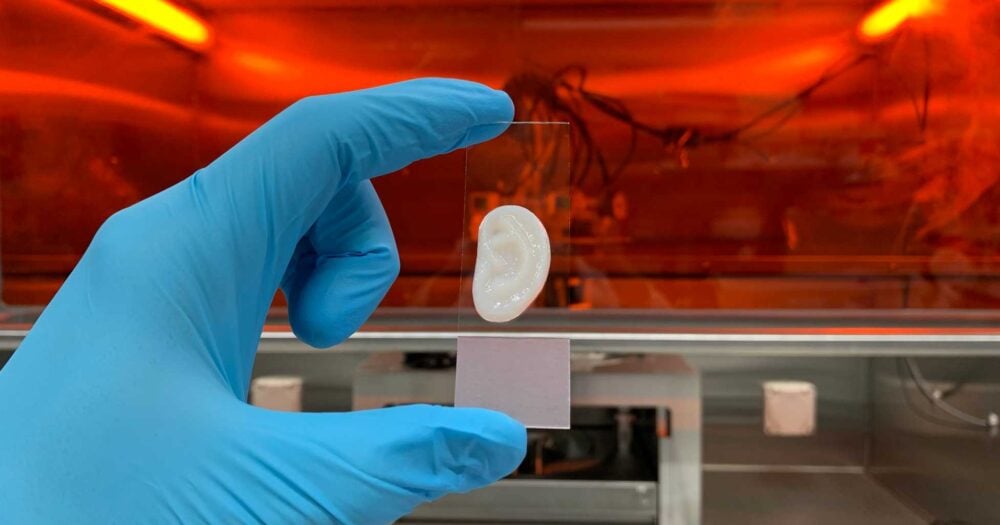
Researchers from ETH Zurich, the Friedrich Miescher Institute, and the Cantonal Hospital of Lucerne have used 3D printing to create elastic ear cartilage with mechanical properties that closely match natural tissue. The team used human ear cartilage cells to produce constructs that kept their shape and flexibility in animal models for six weeks.
This advance could reduce reliance on painful rib cartilage grafts and improve outcomes for people needing ear reconstruction due to birth defects or trauma. The work demonstrates how 3D printing can create stable, functional soft tissues for medical use.
How does it work?
The process starts with small cartilage samples removed during corrective surgeries. From a 3mm piece, researchers can extract roughly 100,000 cells. Since printing a full ear requires hundreds of millions of cells, the team grows the cells in specialized nutrient solutions.
The process involves several key steps:
- Cells are mixed into a gel-like bioink and 3D printed into ear shapes
- The printed tissue matures in incubators for several weeks
- During maturation, the tissue develops collagen, elastin, and other proteins found in natural cartilage
- A special culture system supplies oxygen and nutrients throughout the printed structure
“While the input material is crucial, so too is the tissue’s ability to develop,” said Philipp Fisch, lead author of the study published in Advanced Functional Materials.
After nine weeks of lab-based maturation, the ears were implanted under the skin of rats. Over six weeks, the constructs remained dimensionally stable and mechanically similar to natural cartilage.
Why does it matter?
Many people lose ears due to burns, accidents, or birth defects like microtia, which affects roughly four in 10,000 children. Current reconstruction methods rely on rib cartilage, which can be painful, leave scars, and produce ears that are stiffer than natural ones.
This research addresses several major problems with existing treatments:
- Eliminates the need to harvest cartilage from ribs
- Reduces patient pain and scarring
- Creates ears with natural flexibility
- Allows for patient-specific reconstruction
The technology could also extend beyond ears to other soft tissue replacements in the body.
The context
Despite the progress, significant challenges remain. The team still struggles with elastin production – the protein responsible for the ear’s natural flexibility. “Elastin remains a challenge for us, as we were not able to mature it fully,” said Fisch. “We observed changes in the tissue. That clearly shows that we need to stabilize it further.”
The work is also time-intensive, with each experiment lasting three to four months as researchers work to understand the complex requirements for a stable elastin network.
This research is part of a broader trend in 3D bioprinting. Other teams have made similar advances:
- Researchers at TU Wien developed laser-fabricated porous scaffolds for artificial cartilage
- Teams at the University of Illinois Chicago and UC Davis created constructs with both cartilage and bone regions
- Multiple groups are working on high cell-density bioinks for better tissue printing
Fisch hopes to identify the blueprint for stable elastin networks within five years, which would clear the way for clinical trials and regulatory approval. “Our current study provides a good guide to the current state of research,” he said. “It shows how close we already are to recreating the human ear – and what’s still missing.”