

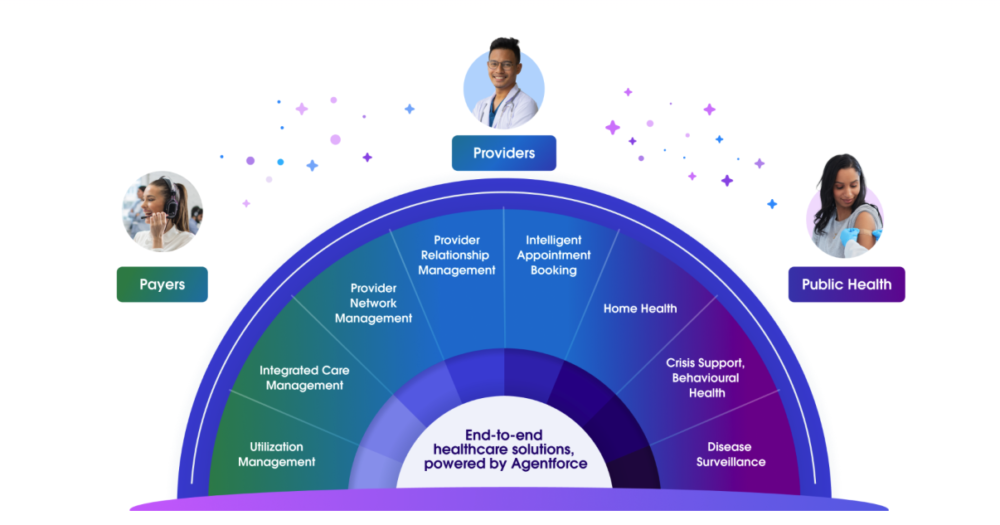
Salesforce has launched six AI agents designed to handle routine healthcare tasks that currently consume hours of staff time. The Agentforce Health platform connects to existing hospital systems, insurance networks, and public health databases to automate everything from patient referrals to bed management.
The company says the system addresses a core problem in healthcare: administrative work that pulls doctors and nurses away from patient care. Instead of manually processing referrals or checking insurance coverage, healthcare workers can let AI agents handle these tasks while they focus on treatment.
How does it work?
Agentforce Health operates through six specialized AI agents that connect directly to healthcare infrastructure:
- Referral agents – Route patients to specialists and populate care plans using medical history
- Authorization agents – Speed up insurance pre-approvals for procedures and medications
- Care coordination agents – Help medical teams communicate and track patient progress
- Coverage agents – Check insurance eligibility and benefits in real time
- Hospital operations agents – Manage bed availability and staffing needs
- Public health agents – Monitor disease outbreaks and coordinate rural care delivery
The platform connects to multiple healthcare data sources:
- HealthEx for secure patient data sharing
- Verily for wearable device and lab data
- Viz.ai for medical imaging analysis
- MuleSoft for electronic health record integration
- FHIR and TEFCA standards for data exchange
Patients control their data through a digital health wallet that lets them choose what information to share and with whom.
Why does it matter?
Healthcare administrative costs consume roughly 30% of total healthcare spending in the US. Much of this comes from manual processes that require staff to switch between different computer systems, make phone calls, and fill out forms.
The AI agents aim to reduce this workload by:
- Automatically processing routine requests that currently require human review
- Connecting data from different systems so staff don’t need to log into multiple platforms
- Providing real-time updates on patient status and resource availability
- Reducing errors that occur when information is manually transferred between systems
Early results suggest significant impact. MIMIT Health, one of the first organizations to use the platform, reports a 459% return on investment and $1.5 million in savings, according to CEO Dr. Paramjit Chopra.
The context
Healthcare AI adoption has accelerated rapidly since 2023, but most implementations focus on specific tasks like medical imaging or drug discovery. Salesforce’s approach differs by targeting operational workflows that affect entire healthcare organizations.
The company faces competition from several directions:
- EHR vendors like Epic and Cerner are building AI features into existing systems
- Tech giants including Google and Microsoft offer healthcare AI tools
- Specialized startups focus on specific workflows like prior authorization or care coordination
Salesforce’s advantage may lie in its existing relationships with healthcare organizations and its ability to integrate with multiple data sources. The company already works with major health systems and insurance companies through its customer relationship management software.
The launch comes as healthcare organizations face staffing shortages and rising operational costs. Many hospitals struggle to fill administrative roles while managing increasing patient volumes and complex insurance requirements.