

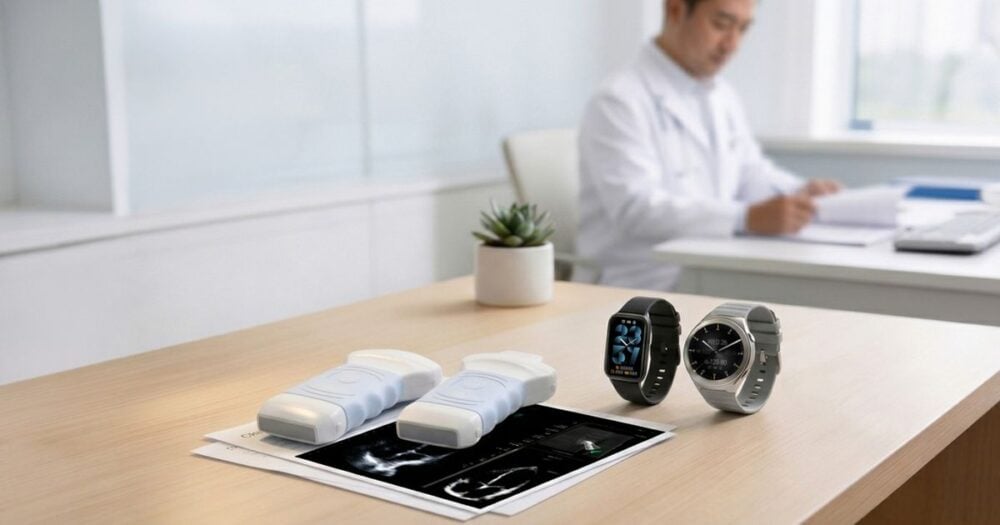
ASUS has launched an AI-powered healthcare ecosystem that connects medical devices directly to clinical decision-making systems. The new platform combines two devices – the ASUS Handheld Ultrasound DuoScan and ASUS VivoWatch 6 Plus – with AI software to help doctors make faster decisions at the patient’s bedside.
The announcement comes as healthcare systems worldwide struggle with staff shortages and increasing patient loads. AI agents – software that can analyze data and recommend actions automatically – are emerging as a potential solution. ASUS surveyed frontline healthcare workers and found 68% expect AI agents to measurably improve clinical workflows.
Portable ultrasound brings hospital imaging anywhere
The ASUS Handheld Ultrasound DuoScan packs 192-element high-definition imaging into a portable device. The dual-probe design comes in two configurations:
- Linear-plus-convex: For abdominal, muscle, blood vessel, and thyroid scans
- Linear-plus-phased array: For heart, abdominal, muscle, and blood vessel imaging
The device has IP68 waterproof and dustproof rating with three hours of battery life. This wireless design means doctors can perform ultrasounds in emergency rooms, intensive care units, or even patients’ homes without being tied to large, stationary machines.
Advanced health watch monitors vital signs continuously
The ASUS VivoWatch 6 Plus builds on the company’s existing health monitoring technology with new features. The watch has a 1.43-inch AMOLED display protected by sapphire crystal glass and a titanium case for durability.
Beyond standard blood pressure and ECG monitoring, the new version adds:
- Sleep breathing movement tracking
- Gait analysis for walking patterns
- Real-time health feedback and coaching
These features aim to detect early signs of chronic diseases and provide personalized health guidance based on continuous data collection.
Connecting devices to clinical decisions
The key innovation is how ASUS connects these devices through what it calls a “medical sandbox.” The system has three layers:
- Sensing layer: The ultrasound and watch devices collect patient data
- Platform layer: ASUS No-Code AI processes and analyzes the information
- Computing layer: ASUS hardware infrastructure runs the AI analysis
This setup creates a closed loop where patient data is continuously captured, analyzed, and turned into actionable recommendations for healthcare providers. The system is designed to work across hospitals, emergency care, and remote healthcare settings.
The healthcare AI market is expected to reach $102 billion by 2028, driven by the need for more efficient patient care and the growing sophistication of AI technology. ASUS is positioning itself to capture part of this market by providing the complete hardware and software stack rather than just individual devices.