

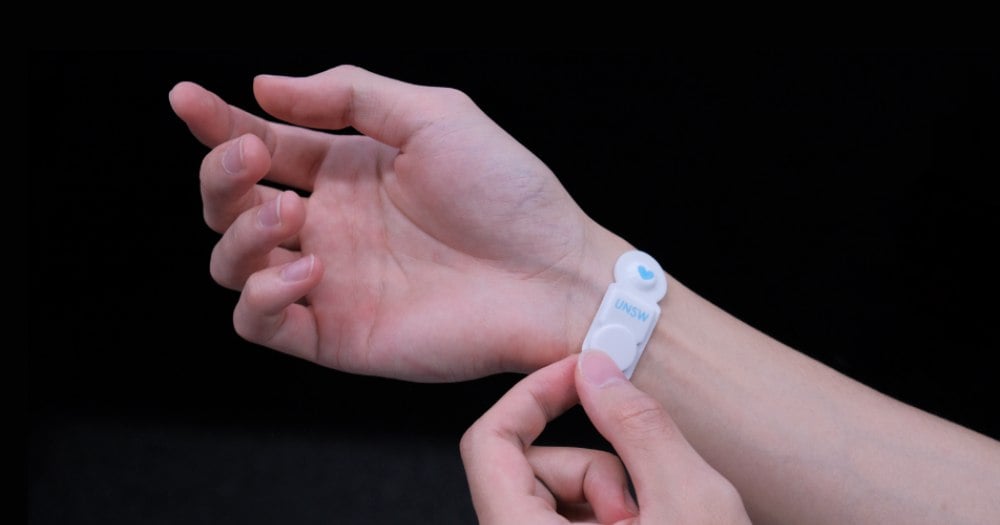
For most people with chronic heart or lung disease, health monitoring happens in brief windows, a 15-minute appointment, an occasional ECG, a stethoscope held to the chest for a few seconds. What happens between those visits is largely unknown to doctors. A new wearable sensor developed at UNSW Sydney is designed to change that.
The device, called AusculPatch, is a flexible patch that sticks to the chest using medical adhesive tape. It weighs just 3.2 grams and measures roughly 20 by 47 millimetres. According to the team behind it, the patch can continuously detect heart sounds, breathing patterns, pulse waves, and blood flow vibrations, capturing the kind of mechanical information that normally requires clinical equipment to measure.
The proof-of-concept research, led by Scientia Associate Professor Hoang-Phuong Phan and published in Nature Communications, involved a small group of healthy participants. Larger clinical trials involving around 200 patients are now being planned, with regulatory approval for a medical-grade device estimated to be roughly four to five years away.
The problem with clinic-only monitoring
Heart disease and chronic respiratory conditions are among the leading causes of death worldwide, yet most patients only get assessed when they actually show up to a clinic. That creates a serious gap, particularly for people in remote areas or those who put off seeking care until symptoms are hard to ignore.
“Sometimes people are hesitant to go to hospital, so they wait until symptoms are clearly developed,” says A/Prof. Phan. By that point, disease may have already progressed significantly.
Dr Anthony Sunjaya, a medical doctor and Program Lead for Chronic Respiratory Disease at UNSW’s School of Population Health, who co-authored the research, put it plainly: “When they go to a clinic, patients often only have a 15-minute window for assessment. The danger is that the abnormalities experienced will not be fully recognised during that short period of time they are being seen.”
How AusculPatch works
At the core of the patch is an ultra-thin silicon sensing element that picks up mechanical vibrations travelling through the skin from the heart, lungs, and blood vessels. Unlike standard microphones built to capture audible sound, this sensor can detect extremely low-frequency vibrations that most wearable technology misses entirely.
“The heart sound propagates through the body fluid and tissue, generates an acoustic pressure that vibrates the sensing element,” says Tran Bach Dang, the paper’s first author and a PhD candidate in UNSW’s School of Mechanical and Manufacturing Engineering. “What the patch is doing is picking up that vibration.”
Ambient noise is a known problem for acoustic wearables, so the team built directional shielding into the sensor. “The sensor element is designed to shield the sound coming from one direction, typically from the human body,” Dang explains. “In that way, it is less susceptible to ambient sound.”
In testing, participants wore the patch during everyday activities, including walking, eating, working, and climbing stairs. The device continued capturing clear heart sounds even in noisy conditions, such as during conversation and under simulated background noise.
What it actually measures
The AusculPatch goes beyond what consumer wearables like smartwatches currently offer. While fitness trackers can read heart rate and blood oxygen levels, they do not capture the mechanical behavior of the heart and lungs directly. The patch records a much wider range of physiological signals:
- Heart sounds, including subtle valve activity
- Breathing patterns and respiratory rate
- Pulse waves and blood flow vibrations
- Blood pressure indicators
In early lab and human testing, the device showed strong agreement with established clinical tools including ECGs, ultrasound scans, blood pressure monitors, and digital stethoscopes.
The AI angle
Continuous monitoring only becomes clinically useful if someone, or something, is actually watching the data. That is where the team sees machine learning playing a key role.
“We can potentially apply machine learning to identify abnormal signals and warn the patients, and also notify their doctor,” says Dr Chi Cong Nguyen, an Associate Lecturer and corresponding author on the paper. “The goal is to create a system that can automatically flag concerning changes before patients experience severe symptoms.”
Because the patch collects physiological data continuously over extended periods, it could generate the kind of dataset needed to train models that recognize early warning signs, something a 15-minute clinic visit simply cannot do.
Other potential uses
The researchers also tested whether the patch could detect vocal cord vibrations when placed near the throat. In early experiments, they used machine learning to recognize spoken words and wirelessly control a robotic arm. Those results are still very preliminary, but the team says the technology could eventually help people with speech disorders or physical disabilities.
What comes next
The research is still at an early stage. The initial trials involved only a small number of healthy participants, which means much larger studies are needed before the technology can be validated for clinical use.
The team, which includes Associate Professor Thanh Nho Do, Scientia Professor Nigel Lovell, and Professor Tracie Barber, plans to test the device on around 200 patients this year, a group expected to include people with heart valve disease or implanted heart assist devices. Studies with up to 1,000 patients are planned for the years following.
A/Prof. Phan estimates a four-to-five year timeline before possible clinical deployment of a medically approved version. A consumer wellness version, with fewer regulatory hurdles, could potentially arrive sooner.