

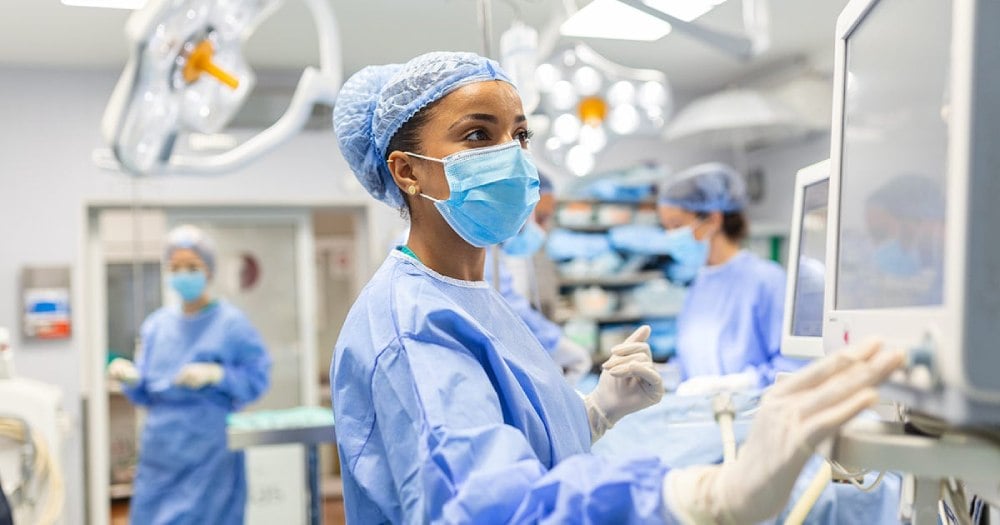
Surgeons are meticulous in the operating room. But when it comes to writing up what happened, the process is surprisingly imprecise. Operative reports are often drafted hours or days after a procedure, relying on memory and generic templates. Peer-reviewed research published in the Journal of the American College of Surgeons found that reports written this way achieve only 72.8% accuracy. That gap has real consequences for patient safety, billing, and care quality.
Oracle Health and surgical AI company Theator want to close that gap. The two companies announced a collaboration that brings Theator’s surgical video analysis technology to Oracle Health customers in the United States. The system captures video from the operating room, analyzes it using AI, and cross-references data from the electronic health record (EHR) to produce a structured operative report automatically, without any dictation or transcription from the surgeon.
The timing fits a broader push across healthcare to automate clinical documentation. AI scribes are already common in outpatient settings, reducing the time doctors spend on notes after patient visits. The operating room has been slower to change, partly because the technical challenge is much harder. Surgical video is data-dense, procedures are complex, and the stakes for errors are high. This partnership is a direct attempt to bring that same documentation shift into surgery.
How the system works
Theator’s platform does more than transcribe audio. It analyzes the surgical video feed itself, recognizing which step of a procedure the surgeon is on, whether safety milestones have been met, and which events are clinically significant. By the time the surgeon leaves the room, a structured operative report is ready for review and sign-off inside their normal workflow.
The platform runs on Oracle Cloud Infrastructure (OCI), which handles the compute-heavy work of processing high-definition surgical video in real time. OCI’s security and scalability matter here because surgical video is sensitive data, and the AI workloads involved are among the most demanding in any clinical setting.
Once complete, the report flows directly into Oracle Health’s EHR, where care teams, quality reviewers, and billing staff can access it immediately. That integration is a key part of what makes this practical for health systems: the data enters existing workflows without requiring separate logins, new systems, or manual transfers.
Why accurate documentation matters beyond the operating room
The benefits go beyond saving surgeons time. Accurate, timely operative reports affect several parts of a health system’s operation:
- Billing and revenue: Vague or incomplete reports lead to coding gaps, which means procedures are often billed below their actual complexity. A report that reflects what really happened supports more accurate reimbursement.
- Quality review: Quality teams need detailed records to track outcomes, flag complications, and benchmark performance across surgeons and facilities.
- Patient safety: When the next care team member reads an operative report, they need an accurate account of what occurred, not a templated summary written from memory.
- Research and benchmarking: Structured surgical data, collected consistently, can support system-wide quality analysis in ways that ad hoc memory-based reports cannot.
What Theator brings to the table
Theator is not a new entrant in this space. The company’s Surgery-to-Text platform has already analyzed more than 600,000 procedures across more than 150 procedure types. It is deployed at academic medical centers in the U.S. and internationally, including Mayo Clinic and UHealth Miami.
Its documentation accuracy has been validated in the same peer-reviewed research cited above, with results showing significantly higher accuracy than memory-based reports (p=0.001). That kind of published validation is important in healthcare, where clinical tools face a high bar for evidence before widespread adoption.
What this means for Oracle Health customers
For health systems already using Oracle Health’s EHR and infrastructure, the integration is designed to fit inside what they have already built. That means the same security controls, compliance frameworks, and clinical workflows they use today, without a separate surgical data silo sitting alongside them.
The collaboration also reflects Oracle Health’s broader strategy of building out an ecosystem of specialized partners rather than trying to build every clinical capability internally. Theator handles the surgical intelligence layer; Oracle provides the infrastructure, EHR integration, and distribution to its customer base.
Seema Verma, executive vice president and general manager of Oracle Health and Life Sciences, pointed to the operating room as one of the last places in medicine where clinical documentation has not yet caught up. The goal, she said, is to reduce the cognitive burden on surgeons while producing records that are more complete and more useful across the system.
Theator CEO Tamir Wolf, MD, PhD, framed it as an infrastructure shift: when surgical data enters the health record with the same structure and reliability as any other clinical encounter, it opens up capabilities like system-wide quality benchmarking and real-time safety analysis that were not previously possible at scale.