

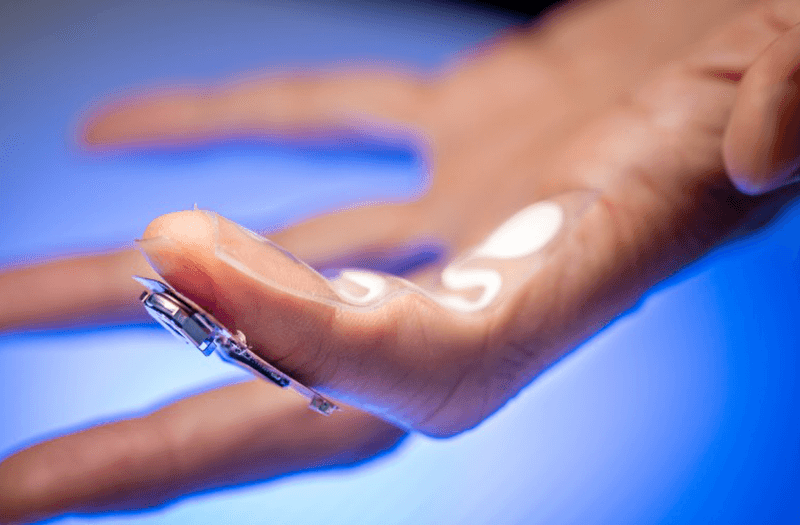
The difference between too much and too little levodopa can be measured in minutes. For people with Parkinson’s disease, that narrow window separates controlled movement from tremors on one side and involuntary dyskinesia on the other. Getting the dose right has always been the central challenge, and until now, clinicians have largely relied on symptom diaries to do it. A new fingertip patch from researchers at the University of California, San Diego may change that.
Published in Proceedings of the National Academy of Sciences, the study describes a battery-free wearable device that continuously monitors levodopa, the primary drug used to manage Parkinson’s symptoms, by sampling sweat from the fingertip. In a small trial, the patch’s readings correlated closely with blood levels measured by high-performance liquid chromatography, the current gold-standard lab method. That’s a meaningful benchmark to hit.
Why dosing levodopa is so difficult
Levodopa has been used to treat Parkinson’s disease since the 1960s. It crosses into the brain and converts to dopamine, the neurotransmitter that patients with Parkinson’s progressively lose. The drug works, but it comes with significant management complexity. Gut enzymes break it down quickly, and long-term use can cause motor complications. The therapeutic window is tight. Too little, and motor symptoms return. Too much, and patients develop uncontrolled movements.
Physicians currently piece together dosing schedules from patient-reported symptom logs, which are subjective and imprecise. Lab tests that can measure exact drug concentrations exist, but results can take weeks. So most patients are managed on educated guesses, not real data.
How the patch works
The device is worn on the fingertip, a sensible choice because fingertip skin contains roughly 400 sweat glands per square centimeter. It consists of hydrogel layers and sensors compressed between two sheets of a rubber-like plastic called styrene-ethylene-butylene-styrene. No battery is needed.
Sweat is absorbed passively through osmosis into a winding internal channel containing a levodopa sensor and a transmitter. When levodopa in the sweat contacts enzymes inside the sensor, a chemical reaction generates a small electrical voltage. That voltage both powers the device and acts as a proxy for drug concentration. Higher levodopa levels produce a stronger signal. Lower levels produce a weaker one.
What the testing showed
The team ran two sets of tests. First, healthy volunteers ate fava beans, which naturally contain levodopa, and the sensor accurately tracked the resulting changes in concentration. The same held when volunteers took levodopa tablets directly.
Then the researchers tested the patch on four patients with Parkinson’s disease. The results were promising:
- Patch readings strongly correlated with blood levodopa levels measured by laboratory analysis
- Peak levodopa levels detected by the patch aligned with periods of fewest motor symptoms
- The device operated continuously without any external power source
- Sweat absorption required no active effort from the patient
That last correlation matters most. It suggests the patch isn’t just measuring a number in sweat. It’s reflecting what’s actually happening neurologically.
The road from wrist to clinic
The researchers envision a future where the patch connects wirelessly to a levodopa pump, creating a closed-loop system that maintains drug levels automatically. That’s still a research ambition, not a near-term product. But the underlying concept is well-established in diabetes care, where continuous glucose monitors now feed data to insulin pumps.
Parkinson’s disease is also a growing public health concern. More than 25 million people worldwide are expected to develop the condition by 2050, with costs in the US alone projected to run into the tens of billions of dollars. Better personalized dosing tools wouldn’t just improve individual outcomes. They would reduce the expensive complications that come from poorly managed long-term levodopa use.
This is early-stage work. Four patients is not a clinical trial. But the performance data is solid, the mechanism is sound, and the unmet need is real. Clinicians managing Parkinson’s patients know exactly how hard it is to optimize levodopa therapy without objective, continuous data. This patch is a serious attempt to provide it.