
More than 1.5 billion people worldwide live with some degree of hearing loss. Most of them don’t own a hearing aid. Cost, stigma, and the friction of getting a clinical appointment all get in the way. Samsung is betting that a feature built into earbuds people already carry can change that math in a meaningful way.
On August 11, 2026, Samsung Electronics announced that its Galaxy Buds Hearing Aid feature has received FDA clearance, allowing compatible Galaxy Buds to function as over-the-counter (OTC) hearing aids for users 18 and older with perceived mild to moderate hearing loss. No prescription required. No clinic visit.
What the feature actually does
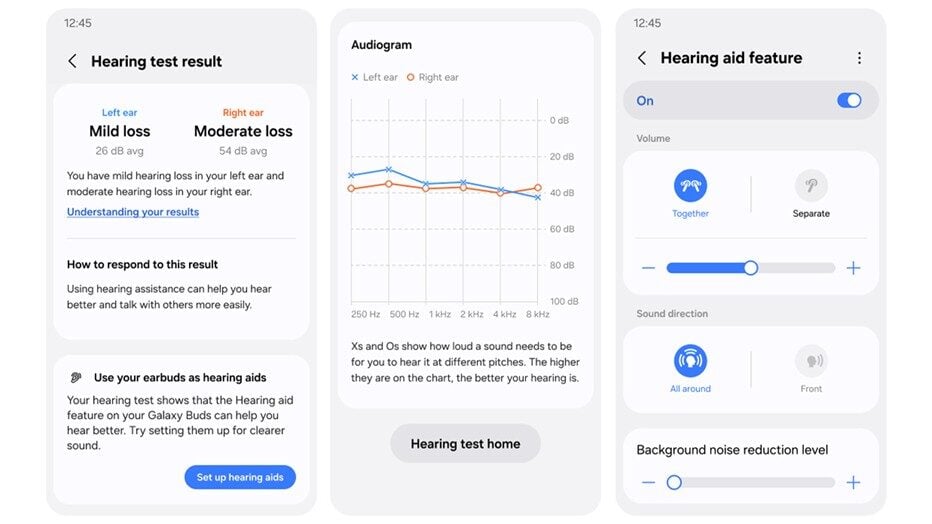
The experience starts with an in-ear hearing test. Users open the Galaxy Buds menu in Settings and complete a five-minute, self-administered assessment based on pure-tone audiometry, the same methodology audiologists use in clinical practice. Each ear is tested individually. The software then generates an audiogram and categorizes hearing as normal or places it into one of four loss stages: mild, moderate, severe, or profound. Samsung has registered this Hearing Test as a Software as a Medical Device (SaMD), which means it has been evaluated to clinical standards, not just consumer-grade wellness standards.
If hearing loss is detected in the mild-to-moderate range, the Hearing Aid feature activates amplification tuned to the user’s specific profile. It targets the frequencies the user actually struggles with, whether that’s high-pitched consonants, distant voices, or ambient conversation in a noisy room. It also includes noise suppression and beamforming, features that typically appear only in premium prescription devices costing thousands of dollars.
The amplification formula behind it is NAL-NL2, the globally recognized clinical standard for fitting prescription hearing aids. That’s not a minor detail. It means the output isn’t just “louder” — it’s calibrated using the same evidence base that professional audiologists rely on.
Years of clinical groundwork
Samsung didn’t arrive here overnight. The company introduced a Personal Sound Amplification Product feature on Galaxy Buds+ back in 2020, and validated it clinically in 2021. The current Hearing Aid feature was developed in collaboration with the National Acoustic Laboratories and Samsung Medical Center, with clinical validation studies run at Vanderbilt University Medical Center, San Jose State University, and the University of Memphis.
That research trail matters. The OTC hearing aid category, opened up in the US in 2022, has attracted a wave of consumer audio brands. But clinical credibility has been uneven. Samsung’s published validation work and use of NAL-NL2 puts it in a different position than many competitors.
The bigger picture for hearing health
The World Health Organization projects that 2.5 billion people will have some degree of hearing loss by 2050. Traditional hearing care infrastructure won’t scale to meet that number. Audiologists are already stretched, devices remain expensive, and the stigma around wearing hearing aids, particularly among working-age adults, keeps many people from seeking help at all.
OTC hearing aids are a direct policy response to that access gap. But software-based solutions built into mainstream consumer devices go a step further. They meet people where they already are.
Hearing-related data, including noise exposure levels and test results, will also appear in the Samsung Health app, giving users a running view of their auditory health over time.
Availability and limitations
The Hearing Aid and Hearing Test features will roll out on Galaxy Buds3 Pro and Galaxy Buds4 Pro in the US and select approved markets in Q4 2026, requiring a compatible Galaxy device running One UI 8 or later. Key points to keep in mind:
- Intended for users 18 and older with mild to moderate hearing loss only
- Not a substitute for professional diagnosis or treatment by a qualified clinician
- Severe or profound hearing loss will not be addressed by this feature
- Availability varies by market and paired device compatibility
For clinicians, the message is straightforward: patients with untreated mild-to-moderate loss now have a low-barrier option worth discussing. It won’t replace audiology. But for the large population that currently has nothing, it could make a real difference.