

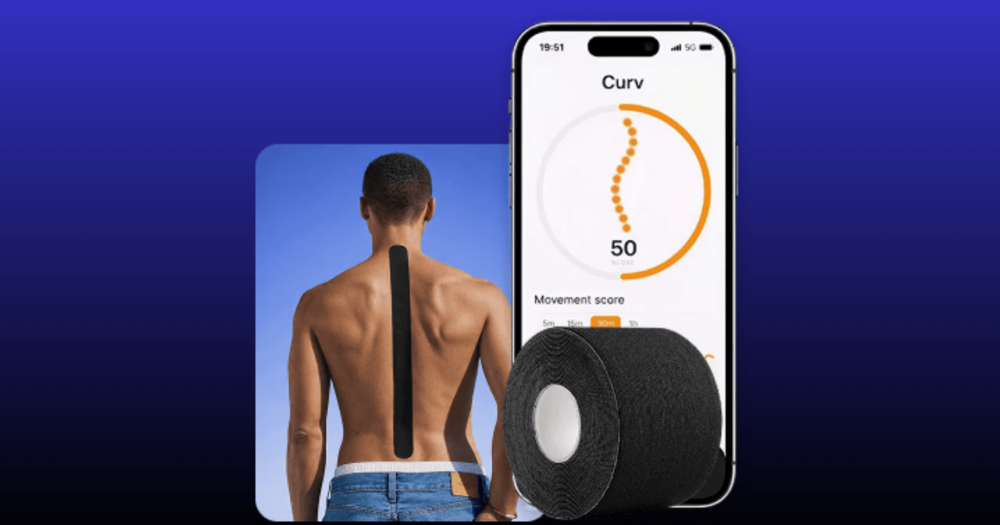
Most back pain devices on the market are built around a myth. The posture-correcting gadgets that buzz when you slouch, the braces that hold you rigid — they share a common assumption that a ‘correct’ position is the goal. Clinically, that’s not what the evidence says. And that gap between popular belief and clinical reality is exactly where CurvLabs is trying to build something useful.
The London-based startup was founded by Rohan Kotecha, who was diagnosed with non-specific back pain at 13. After years of cycling through physiotherapists, chiropractors and osteopaths, he noticed something no one had solved: clinicians saw him for 30 minutes a week and had no idea how he was moving the other 167 hours. During COVID, while studying biomedical engineering at University College London and facing a six-month NHS wait, he started thinking about whether continuous spinal tracking was even possible. He was already building an ECG for a university project. If heart activity could be measured around the clock, he reasoned, why not spinal movement?
What the device actually does
The result is Curv, a wearable sensor built into a strip of kinesiology tape. It adheres along the spine, follows the natural contour of the back, and connects to a smartphone app via Bluetooth. Throughout the day, it tracks range of motion, movement velocity, and which segments of the spine are moving freely versus staying stiff. The device is manufactured in the UK, though Kotecha spent time in Shenzhen earlier for faster prototyping.
The app generates end-of-day summaries and suggests one practical action for the user to take. But the more clinically interesting outputs go deeper than simple movement counts.
Why movement variability matters more than posture
Kotecha spent months before any product development talking to physiotherapists, osteopaths, researchers and clinicians, asking which measurements would actually mean something in practice. One concept kept coming up: movement variability. People with chronic pain often become fearful of moving and adopt rigid, guarded patterns. As confidence returns, movement naturally becomes more varied. Kotecha thinks this could become a meaningful biomarker for musculoskeletal health — comparable to heart rate variability in cardiac monitoring.
The platform also tracks whether users are moving enough to support spinal disc health. Spinal discs are avascular, meaning they have no direct blood supply and rely on movement to receive nutrients. CurvLabs uses continuous data to estimate whether that basic physiological need is being met. It’s a simplified model, but it points toward the kind of insight that a twice-monthly clinic visit simply cannot produce.
Built with patients, not just for them
Kotecha’s first users didn’t come from a clinical trial or a product launch. They came from Reddit’s r/backpain community — people who had lived with the condition and were frustrated by the same gaps he was. That community became a product development resource.
- Early users skewed younger than expected, mostly under 35 and predominantly desk workers
- Most already wore fitness trackers but had no data on the condition actually affecting their lives
- User feedback directly shaped which metrics the app surfaces and how insights are presented
- Clinician input guided the decision to avoid posture alerts, which many physiotherapists advise against
The clinical opportunity — and the gap it fills
Back pain is one of the most common and costly conditions in healthcare, and outcomes have been stubbornly difficult to improve. Part of the problem is data. A physiotherapist working from brief clinic observations and patient-reported symptoms is, in effect, flying partially blind. Continuous movement data, collected passively in real life, changes that. It doesn’t replace clinical judgment, but it gives clinicians something to work with between appointments.
That’s the case CurvLabs is making. And whether or not the biomarkers it’s tracking prove out in larger studies, the underlying premise — that 30 minutes of observation per week is not enough to understand a movement disorder — is hard to argue with.