

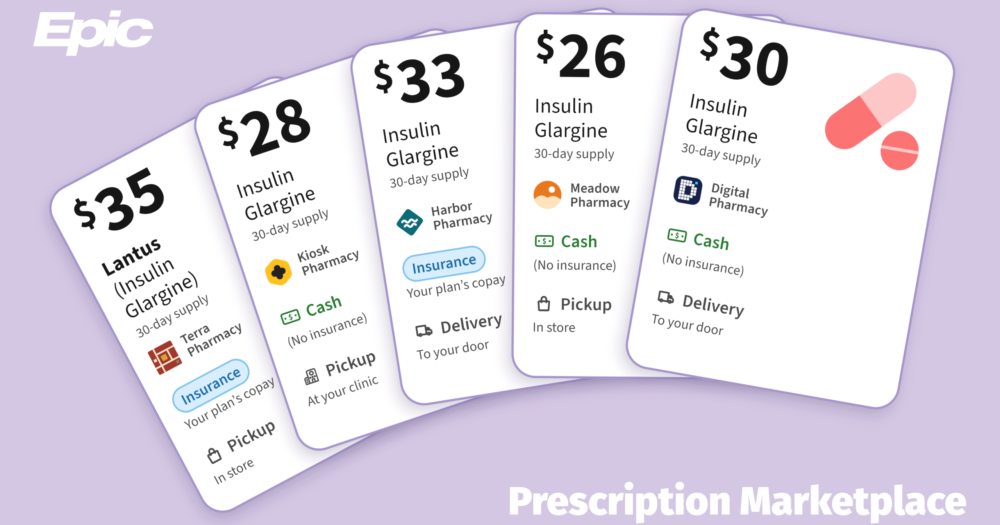
Sometimes the cheapest way to buy a prescription is to ignore your insurance. Patients rarely learn that until they’re standing at the pharmacy counter, and by then many simply walk away. Epic, the electronic health record vendor behind many of the largest U.S. health systems, plans to move that price comparison into the clinic visit itself.
The tool is called Prescription Marketplace. Epic announced it on October 15, 2026, and plans to release it in summer 2027.
What Prescription Marketplace does
Clinicians and patients at health systems using Epic will be able to see what a medication costs at different pharmacies, with and without insurance, before the prescription is sent. Any pharmacy can share its cash prices with Epic health systems. Cash price means what a pharmacy charges a person paying out of pocket. Depending on the drug, the insurance plan and the pharmacy, that number can sometimes beat the insured copay.
The feature builds on Epic’s Real-Time Prescription Benefit tool, which already shows prescribers what a patient will pay under their plan, along with generic alternatives. Epic says that tool helped patients save more than $250 million in 2025.
Why it matters
Cost is a clinical problem. Epic cites data showing more than 40% of American adults do not take their medications as prescribed because of price. A drug that goes unfilled does nothing, however well it was chosen. Pharmacy abandonment is a quiet source of poor control in chronic disease, and it rarely shows up in the chart.
Until now, cash prices have mostly lived outside the clinical workflow. Patients who knew to check discount programs or direct-to-consumer pharmacies could save money. Everyone else paid whatever the insurance adjudication produced. Putting both numbers in front of the prescriber and patient at the same moment changes who gets to find the lower price.
Who is involved
Several pharmacies are taking part, and their incentives are plain. Mark Cuban Cost Plus Drugs is helping build the feature. Co-founder Mark Cuban offered an example: if insurance says a drug costs $500 but the same drug is $100 on CostPlusDrugs.com, the patient should know before leaving the office.
Amazon Pharmacy has worked with Epic since early 2025 on development and offers home delivery or pickup at kiosks where available. Costco and Eli Lilly’s LillyDirect are also involved. Costco’s Ricky Li said clear pricing can reduce abandonment at the counter and help close care gaps.
What to watch
This is an announcement, not a study, and there are no outcome data yet. The $250 million figure for the existing benefit tool is Epic’s own number. Several questions will decide how useful the marketplace is:
- How many pharmacies, including independents and local chains, actually share prices
- How current and accurate the cash prices are at the moment of prescribing
- Whether cash purchases are tracked, since they bypass insurance and can leave gaps in a patient’s deductible and medication history
- How clinicians fit another decision point into already crowded visits
Still, the direction is sensible. Price transparency has been a policy goal for years, and its value depends on reaching people at the moment of decision. Amazon Pharmacy, Costco and Eli Lilly will discuss medication affordability at the Open@Epic conference in Verona, Wisconsin on October 21.