

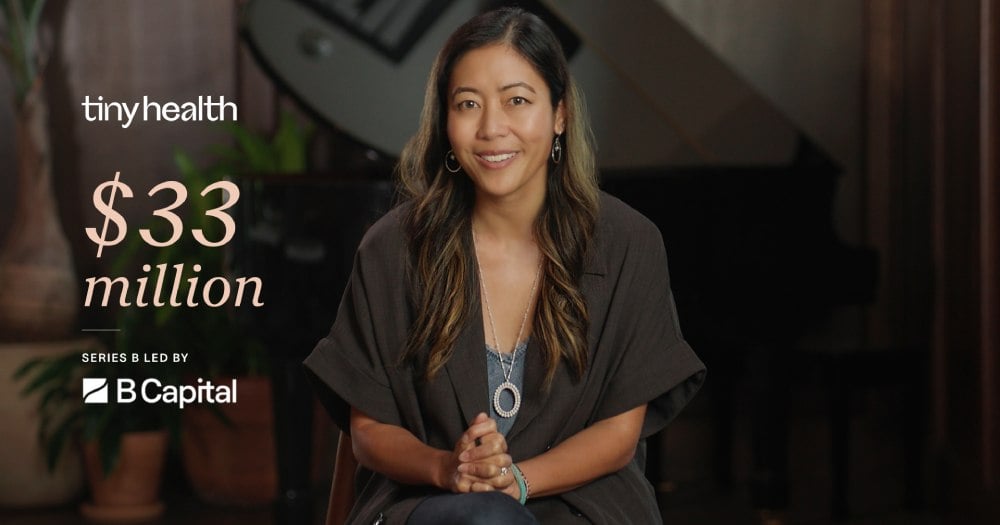
Most microbiome companies sell the story. Tiny Health is one of the few that has actually run the trial. In 2025, the Austin-based company published an interventional randomized controlled trial in Pediatric Allergy and Immunology showing that targeted microbiome interventions reduced infants’ odds of developing eczema by 83%. That single data point separates Tiny Health from a crowded field of gut health startups where peer-reviewed evidence is still rare. Now, with a $33 million Series B led by B Capital, the company is putting that scientific credibility to work at scale.
The round was oversubscribed and brings total funding to $46 million. Existing investors Spero Ventures, The Venture City, and Overwater Ventures participated alongside new backers including Black Opal Ventures, Denver Ventures, Pave Health Ventures, Alumni Ventures, Gaingels, and Pari Passu Ventures. Nick Whitehead, Senior Principal at B Capital, will join the board.
Why this raise matters beyond the headline number
The timing reflects something real happening in medicine. The CDC and JAMA both reported in 2025 that roughly 75% of U.S. adults and 45% of U.S. children are living with at least one chronic condition. Clinicians and researchers are increasingly looking at the gut microbiome not as a wellness add-on but as a factor that may sit upstream of immune dysregulation, metabolic disease, and chronic inflammation. The question has shifted from whether the microbiome matters to how to measure and act on it reliably.
That’s where Tiny Health’s technical foundation becomes relevant. The company owns its full bioinformatics pipeline in-house, uses shotgun metagenomic sequencing (which detects microbes across more than 120,000 genomes down to the strain level), and has built what it describes as one of the world’s largest longitudinal microbiome datasets, now containing nearly 200,000 profiles. A second RCT is already underway, and active research is expanding into IBD, menopause, GLP-1 response, and oncology drug response.
TinyAI and the clinical intelligence layer
Part of the new capital will go toward accelerating TinyAI, the company’s AI system trained exclusively on its proprietary dataset. The pitch is specific: as the dataset grows, the model’s guidance becomes more precise, connecting a user’s actual microbiome results to evidence-based recommendations rather than generic advice. For practitioners ordering tests through Tiny Health’s platform, that means interpretation support grounded in a dataset that no outside tool can replicate. Whether TinyAI delivers on that in practice will depend on ongoing clinical validation, but the architecture is at least built on a defensible data advantage.
A $5 million research program opens the platform to outside scientists
Alongside the funding announcement, Tiny Health is committing $5 million to a new Microbiome Research Program. The goal is to give external researchers, clinicians, and scientific partners access to the company’s testing infrastructure, data, and research capabilities to investigate intervention strategies in microbiome health. Chief Science Officer Kimberley Sukhum, PhD, framed it as a way to bring more institutions into the field and build on the company’s existing body of peer-reviewed work.
This is a meaningful move. One of the persistent criticisms of direct-to-consumer health data companies is that their datasets stay proprietary and inaccessible to independent scientists. Opening a structured research program doesn’t fully resolve that tension, but it does create a pathway for external validation and collaboration with institutions like Stanford Medicine, Mayo Clinic, and Massachusetts General Hospital, all of which already have relationships with Tiny Health.
From infant gut health to longevity clinics
Tiny Health launched in 2022 with a gut microbiome test for babies and testing for mothers, grounded in early-life biology. The first 1,000 days of life remain central to the company’s scientific framework because that window is when the gut microbiome is most malleable and its influence on long-term immune health is strongest.
But the platform has expanded well beyond that origin. Adult testing has now overtaken pediatric testing in volume. New tools including Gut Microbiome Age, Gut Resilience, and Gut Body Connections are aimed at longevity and healthy aging use cases. The company’s B2B platform, Powered by Tiny, grew fourfold last year and now counts Mayo Clinic’s Executive Health and Longevity Programs, Atria Institute, Superpower, and Fullscript among its enterprise partners.
- Nearly 200,000 customers served to date
- More than 6,000 healthcare practitioners across independent practices, hospital systems, and longevity clinics
- Four published scientific papers with a second RCT in progress
- Powered by Tiny B2B platform grew 4x in the past year
- Active research programs in IBD, menopause, GLP-1 response, and oncology
For clinicians evaluating microbiome testing options, Tiny Health’s combination of published trials, in-house sequencing infrastructure, and practitioner-facing tools puts it in a different category from most consumer wellness offerings. The company is not yet a standard-of-care recommendation, and the broader field of microbiome medicine is still building its clinical evidence base. But Tiny Health is doing more of the right kind of work, faster, than most of its competitors. That’s what this funding round is designed to sustain.