

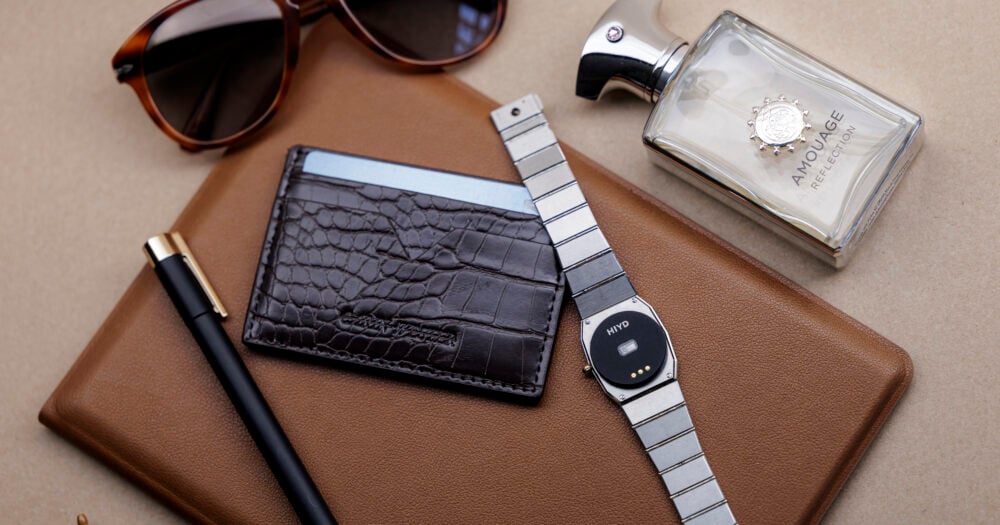
Most people who wear a Rolex, a Cartier, or even a well-loved vintage Seiko are not about to swap it for a rubber-strapped fitness band. That tension between personal style and health monitoring has been quietly limiting wearable adoption for years. Hiyd, a startup founded by ex-Apple engineer Salah Batroukh, is betting that the answer isn’t a better smartwatch. It’s a sensor that disappears entirely.
A disc that hides in plain sight
Hiyd’s first product is a small circular sensor that attaches to the back of any watch using microsuction, a textured silicone material with hundreds of tiny air pockets per square inch. Press it against a surface and it creates a vacuum, similar in principle to a suction cup but far thinner and far more precise. The disc measures 2.7 mm thick and weighs 7 grams. It sits flush against the watch case, leaves no residue, and uses no magnets, which matters because many mechanical watches use magnetic components for regulation or anti-shock protection.
“It works incredibly at stopping shear forces, but a little bit of prying allows it to pop right off,” Batroukh told TechCrunch. The microsuction layer itself is just 0.3 mm thick, achieved through what the company describes as a refined manufacturing process.
What it actually measures
Despite its size, the sensor collects a meaningful range of biometrics. According to Batroukh, it tracks:
- Heart rate and heart rate variability
- Sleep staging
- Movement and activity classification
- Calories burned
- VO2 max estimations
Data syncs to an iOS or Android app. To train the activity-classification models, the Hiyd team is recording themselves performing different activities and manually labeling the data sets. It’s a methodical, if resource-intensive, approach. “The one thing that AI is really good at is data analysis, so we can basically fit a lot of heuristic analysis into our sets really quickly,” Batroukh said.
Nutrition insights without the calorie obsession
The app is also being built to incorporate nutrition tracking, though not in the way most diet apps approach it. The focus isn’t on logging macros or hitting calorie targets. Instead, Hiyd wants to connect eating patterns to outcomes users can actually feel, like sleep quality and workout performance.
The pitch is personalized rather than prescriptive. Think alerts like: your sleep was lighter last night, possibly because you ate something sugary close to bedtime. Or: your recovery metrics are consistently better on days you exercise in the morning rather than the evening. That kind of contextual feedback is harder to deliver than a step count, but it’s also considerably more useful for behavior change.
The Apple alumni angle
Batroukh spent seven years as a manufacturing design engineer at Apple before founding Hiyd. He’s joined by CTO Omar Shakir, a mechanical engineer, and head of software Mahamad Charawi, who previously co-led the Y Combinator-backed startup Laudspeaker through its acquisition.
Batroukh is candid about why he left one of the most recognizable hardware companies on earth. “A lot of the products became a little bit more about being an Apple product, rather than being something for the customer,” he said. Hiyd, in his framing, is a chance to prove the product can carry the weight without the brand.
Availability and what comes next
Hiyd is competing in the top 20 at Startup Battlefield during TechCrunch Disrupt. The company plans to launch a Kickstarter campaign in November, and more than 16,000 people have already placed deposits to secure early units.
The broader concept, what Batroukh calls “invisible health tracking,” is ambitious. But the underlying insight is sound. If health monitoring only reaches people willing to change how they dress, it will always miss a significant share of the population. A sensor that works with the watch you already love, rather than replacing it, is a real answer to a real problem.