

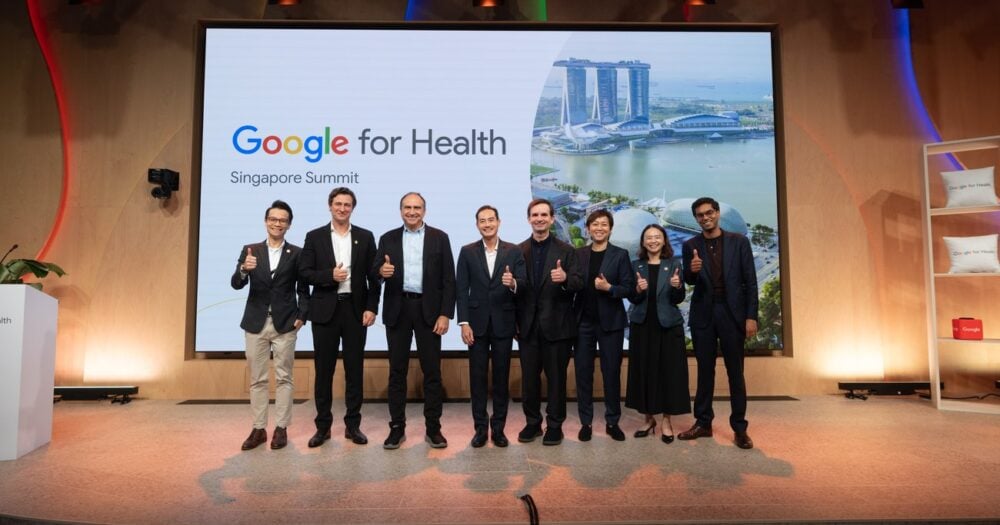
Plenty of companies announce AI health partnerships. Few pick a whole country as the proving ground. Google’s latest announcement at its Google for Health Summit in Singapore does exactly that, pairing a new local research hub with deployments inside the city-state’s public healthcare institutions.
The company says the goals are to speed up scientific discovery, support frontline clinicians and give residents better tools to manage their own health. Most of the detail is early-stage, and none of it comes with outcome data yet. But the structure of the program is worth watching.
A research hub with local roots
Google Research is setting up a Singapore hub staffed by research scientists and software engineers. Its focus is foundational AI models, and it will work with the National University of Singapore and Nanyang Technological University on research support and talent development.
The company will also expand existing health research in the country. That includes bringing open models such as MedGemma into frontline care settings. Because the models are open, hospitals can build customized tools while keeping full control of their data. Data sovereignty is a recurring theme here, and for good reason. Health systems are wary of sending patient information beyond their own walls.
On the funding side, Google.org and Google DeepMind are contributing $7 million to the Philanthropy Asia Alliance’s Health for Human Potential Coalition. Of that, $1 million goes to PathGen, an AI platform that helps countries detect disease threats sooner and share data for public health intelligence, again without moving data out of the country.
Two clinical tests
The most concrete work involves clinicians and patients. Google DeepMind is working with the National University Health System to evaluate an AI co-clinician tool. It helps doctors synthesize medical guidelines and literature and answers clinical queries while they care for patients. Note the word evaluate. This is an assessment, not a rollout, and the results will matter more than the announcement.
Separately, Google Cloud is partnering with NHG Health on a population health program. AI-driven predictive models forecast risks such as chronic conditions across sub-populations. Those forecasts feed an AI health coach inside the NHG HealthBot, built on Google’s Gemini Enterprise for Customer Experience platform. Residents receive personalized lifestyle guidance and preventive care reminders.
Why it matters
Singapore, like many countries, faces an aging population and pressure to shift from treating illness to preventing it. Prediction tools that flag risk early, paired with a coach that nudges behavior, fit that need neatly. Whether they change outcomes is the open question.
Google itself acknowledges that technology is only part of the answer. Health systems also have to integrate AI responsibly, govern it safely and turn it into human-centered care. That is the right caveat. Clinical decision support tools have a long record of working in demos and stalling in workflow.
Singapore is a sensible place to test this. It has a centralized public system, strong academic partners and clear data rules. If the co-clinician and population health pilots produce credible evidence, other countries will have a template. If they don’t, that will be informative too.