

Stroke treatment has a geography problem, and no amount of clinical skill fixes it. Mechanical thrombectomy is the gold standard for large vessel occlusion, yet only a small number of hospitals can offer it. Remedy Robotics, a San Francisco company, just raised $62M in Series B funding to attack that gap with a robot rather than a new hospital wing.
DCVC led the round, returning after earlier backing. New investors include UC Investments, Skip Capital and the Australian pension fund Hostplus. Returning backers include Build Collective (Tony Fadell’s firm), Blackbird, Divergent Capital and KdT Ventures.
What the N1 System does
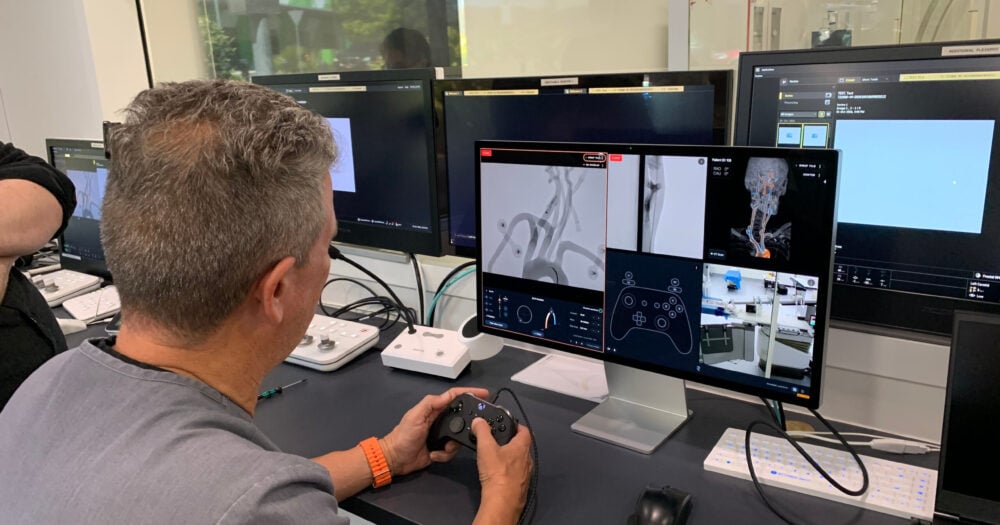
The N1 is a catheter-driving robot paired with machine learning software. It can run on-site, be tele-operated from a remote hub, and over time, operate with increasing autonomy. Remedy is aiming at neurovascular, coronary and peripheral vascular procedures, though stroke is the lead use case.
Before access, the software analyzes preoperative CT and angiographic imaging to simulate a patient’s specific anatomy, including vessel tortuosity. During the procedure, it registers 3D preoperative maps onto live 2D fluoroscopy. That lets a remote interventionalist guide microcatheters and stent retrievers through cerebral arteries with what the company describes as sub-millimeter precision. The company holds 48 issued patents and says it works with more than 100 hospitals worldwide.
Where the money goes
The funding has three main jobs:
- Run a pivotal neurovascular clinical trial in partnership with the University of California network.
- Expand prototype deployments through alliances including SVIN Mission Thrombectomy and the Australian Stroke Alliance.
- Speed up development of autonomous robotic software.
Why it matters clinically
In stroke, time is brain. Every transfer between hospitals adds delay, and delay costs neurons. Remote robotic intervention could, in theory, let a local hospital start thrombectomy without waiting for a patient to be moved or a specialist to arrive. That matters most in rural regions and in a country like Australia, where distances are long and neurointerventionalists are few.
CEO Dr. David Bell put it plainly: access is limited, treatment is often delayed, and complications are “frustratingly common.” The company’s goal is to bring quality intervention to patients regardless of geography.
What to watch
Still, a funding round is not evidence. The pivotal trial will have to show that remote robotic thrombectomy matches the safety and efficacy of manual procedures, including reperfusion rates, procedure times and complication rates. Latency, network reliability and how a local team handles an emergency mid-procedure are open practical questions. And autonomy raises its own regulatory bar. The FDA will want to see where human oversight sits.
The investor mix is worth noting too. A university system and a large pension fund suggest patient capital, which a device company facing a long trial and review cycle needs. If the data hold up, the N1 could change how stroke networks are built. If they don’t, the geography problem remains, and the search for a fix continues.