

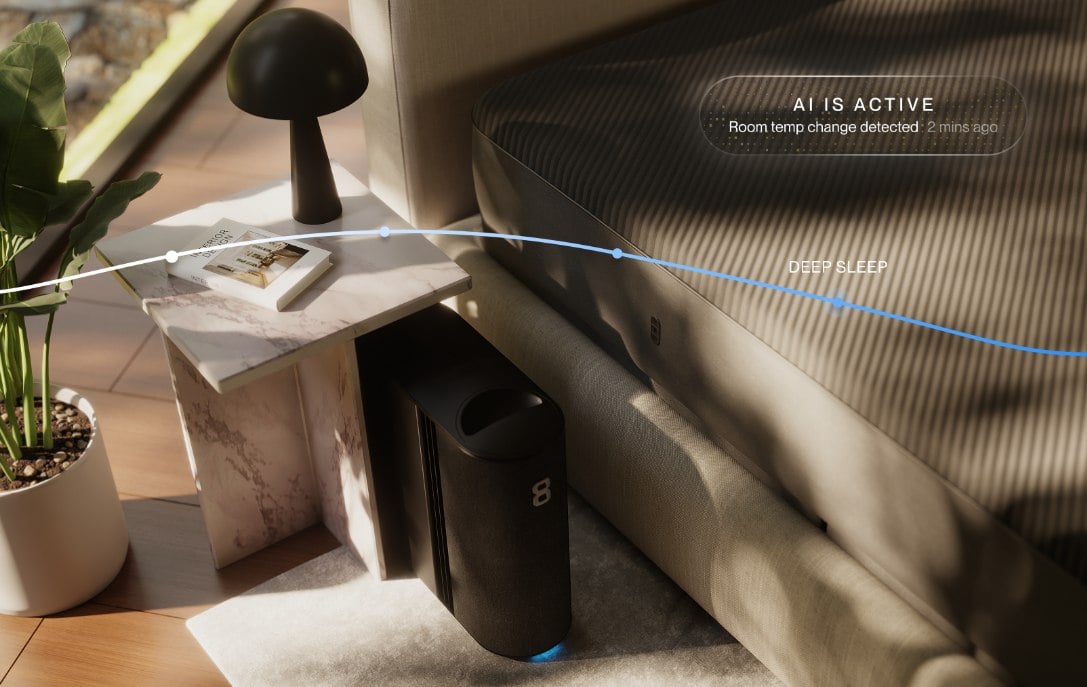
Eight Sleep just raised money at a $1.5 billion valuation. But the sleep tech company isn’t just improving how you sleep anymore. It’s building AI that predicts health problems before they happen.
The round was led by Tether Investments. Eight Sleep plans to use the money to expand beyond sleep optimization into what it calls “predictive AI health.” The idea is simple: instead of reacting to problems, the system anticipates them and intervenes first.
This comes after a strong 2025 for the company. Eight Sleep reached positive cash flow while launching three new products and expanding to 34 countries. Two peer-reviewed studies showed their Pod device reduces menopausal hot flashes by 56% and restores natural circadian temperature rhythms during sleep.
How does it work?
Eight Sleep’s Pod already tracks your biometrics while you sleep. It monitors sleep stages, heart rate, and heart rate variability. Then it automatically adjusts temperature and elevation to improve your rest. Until now, this has been reactive – the system reads signals during the night and makes real-time changes.
The new approach is different. Eight Sleep is building a predictive AI agent that anticipates how your night will go before you even get into bed. The system runs thousands of simulations – what if the room is warm, you exercised late, ate a big meal, or you’re stressed? Then it optimizes your sleep environment in advance.
The AI trains on more than one billion hours of real-world sleep data from users in over 35 countries. Early tests of daytime AI guidance are already changing behavior. Nearly half of pilot participants adjusted their activity timing, caffeine intake, or sleep schedules based on automated insights.
Why does it matter?
Eight Sleep is moving into regulated health territory. The company is filing with the FDA for sleep apnea detection and treatment capabilities. FDA clearance would turn the Pod from a wellness gadget into a medical device that can screen, detect, and treat conditions at scale – passively, every night.
“Sleep was just the beginning,” said Matteo Franceschetti, Eight Sleep’s co-founder and CEO. “We’ve built the most advanced AI-powered health sensing system in the world. This investment gives us the resources to take that intelligence beyond the bedroom and into every dimension of personal health.”
Paolo Ardoino, CEO of Tether, sees bigger potential. “Eight Sleep has the potential to define the future of health tech by building intelligence that learns, scales, and evolves directly with humankind,” he said. “By helping people better understand sleep, recovery, and long-term health, Eight Sleep is laying the groundwork for a new standard in longevity-focused technology.”
The context
Eight Sleep pioneered what it calls “sleep fitness” by combining technology, physiology, and data. Professional athletes like F1 driver Charles Leclerc and tennis player Taylor Fritz use their products. Fast Company named it one of the Most Innovative Companies three times, and TIME twice included it in “Best Inventions of the Year.”
The company will spend the new funding on three areas: scaling R&D to speed up predictive model development, expanding clinical trials and regulatory work, and deepening commercial partnerships globally. Products are now available in over 34 countries.
The shift from sleep optimization to predictive health puts Eight Sleep in competition with a growing field of health tech companies. But their billion-hour dataset and existing hardware in bedrooms worldwide gives them a head start in the race to predict and prevent health problems before they happen.