

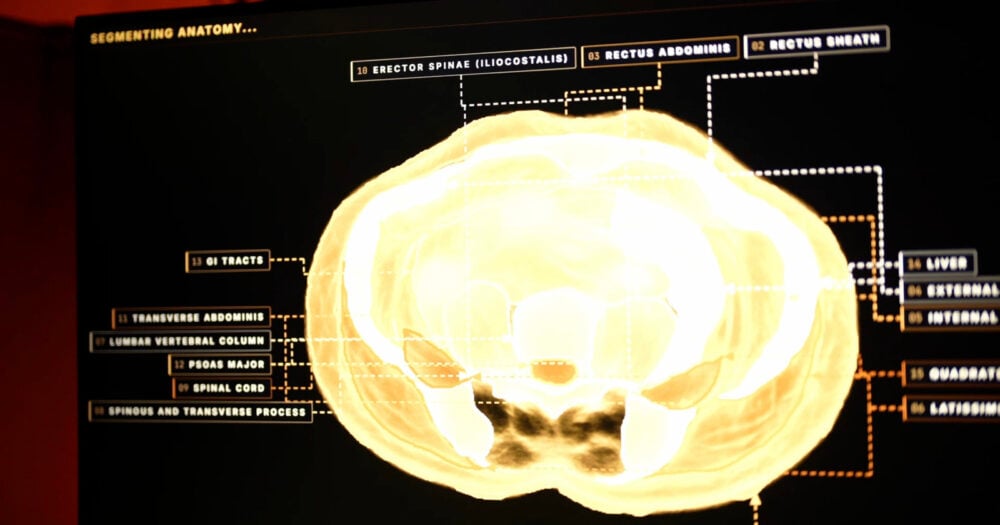
Midjourney has announced something nobody expected from an AI image generator: a medical scanning machine that can map your entire body in under 60 seconds using ultrasound technology. The company is also building dedicated spas where people can walk in and get scanned. It’s a sharp left turn for a company best known for turning text prompts into artwork.
The announcement caught many observers off guard, and understandably so. Midjourney openly admits this has nothing to do with anything it has built before. But the company says it’s asking itself bigger questions now, like what it wants to become and how it wants to stand apart. Its answer is Midjourney Medical, with the Scanner as its first physical product.
“We’ve dreamed of something as powerful as MRI, and as casual as a trip to the spa,” the company wrote in its blog post. That framing tells you a lot about what Midjourney is going for: medical-grade imaging without the clinical intimidation of a hospital.
How the scanner actually works
The machine uses ultrasound, not radiation, which makes it fundamentally different from X-rays or CT scans. Here’s how a session works:
- You step onto a platform and the machine slowly submerges you in water at about 2 inches per second
- Your body passes through a ring packed with half a million tiny squares, each about the size of a grain of sand
- Each square can both emit ultrasonic waves and pick up the ripples that bounce back from your body
- The data is processed into a detailed 3D map of your body
Midjourney compares the effect to being surrounded by half a million tiny dolphins using echolocation simultaneously. The result is described as looking similar to an MRI scan but produced in a fraction of the time. A full-body MRI typically takes 60 to 90 minutes. Midjourney’s target is under 60 seconds.
The technology behind it
Midjourney isn’t building this alone. The company partnered with Butterfly Network, a maker of handheld ultrasound devices, signing a licensing agreement in November 2025 that gives Midjourney exclusive rights to Butterfly’s ultrasound-on-chip technology. That chip technology is what makes it possible to pack so many ultrasound sensors into a single compact ring.
The project is led by Tom Calloway, PhD, who heads up medical research at Midjourney.
The roadmap to get there
Midjourney has laid out a clear timeline, though plenty can change between now and the finish line:
- Next 12 months: Algorithm refinement, research trials, and work on a second-generation hardware design
- 2027: First Midjourney Spa opens in San Francisco, housing the scanners for public use
- Ongoing: FDA approval process for diagnostic capabilities
- 2028: Expansion to more cities and launch of a third-generation machine using custom silicon for significantly better image quality
- 2031: Target of 50,000 scanners deployed worldwide
The FDA approval step is the one that will determine how useful these scanners actually become for healthcare. Right now, they can produce detailed images, but without regulatory sign-off, they can’t be used to formally diagnose conditions.
Why Midjourney thinks this matters
The company is making a bold claim about what widespread early imaging could do at a global scale. “We think it’s completely possible that with enough early imaging in the future, the world could avoid 30 percent of all deaths and 50 percent of all healthcare costs,” Midjourney said in its announcement.
That’s an ambitious number, but the underlying logic isn’t new. Early detection of conditions like cancer, cardiovascular disease, and organ abnormalities consistently leads to better outcomes and cheaper treatment. The barrier has always been access: MRI machines are expensive, slow, and often require a doctor’s referral to access. A 60-second scan available at a walk-in spa, if it delivers on that promise, would change the calculus significantly.
Whether Midjourney can pull this off is another question entirely. Building consumer hardware at scale, getting FDA clearance, and convincing the medical establishment to take a spa-based ultrasound scanner seriously are all separate, difficult problems. But the company has deep pockets and a track record of moving fast in unexpected directions. For now, all eyes will be on that first San Francisco location when it opens next year.