

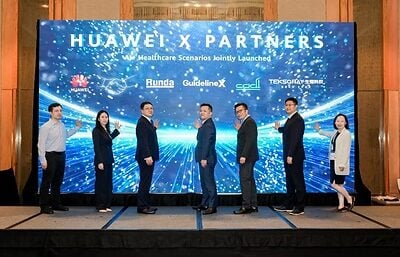
Most AI health announcements stop at the demo stage. What made Huawei’s appearance at HIMSS26 APAC in Singapore worth paying attention to was the specificity: four defined clinical scenarios, named partners, named infrastructure, and a clear attempt to tie AI capability to real hospital problems. That’s a different kind of conversation than the usual conference-floor enthusiasm.
Held at Marina Bay Sands on September 7, 2026, Huawei’s ‘AI for Health, Health for All’ forum drew more than 100 healthcare leaders and industry partners from across the Asia-Pacific region. The headline outcome was the joint launch of four AI+ Healthcare Solution Scenarios, each built around a specific clinical or operational workflow and each developed with a specialist partner.
Smart wards: from periodic checks to continuous monitoring
The first scenario was developed with Cadi Scientific and Lachesis. The AI+ Smart Ward Solution combines continuous vital-sign monitoring, intelligent sensing, real-time location systems (RTLS), and smart medical carts. The goal is to shift ward care from periodic nursing observations to continuous patient monitoring, catching deterioration earlier and reducing the reactive scrambles that strain nursing staff. It also targets repetitive documentation and point-of-care workflow bottlenecks, which remain a significant source of nursing burden in hospitals across the region.
Pathology: digitising the slide, extending specialist reach
In pathology, Huawei partnered with TEKSQRAY to replace manual microscope-based slide review with AI-powered analysis of digitised pathology images, backed by Huawei OceanStor storage infrastructure. The case here is partly about speed and consistency, but it’s also about geography. Pathology expertise is unevenly distributed across APAC, and digital pathology with AI triage has real potential to extend diagnostic quality to facilities that don’t have access to specialist pathologists on-site. The solution also positions institutions to move from single-case diagnosis toward population-level pattern recognition over time.
Clinical decision support: AI in the room where decisions are made
Huawei’s collaboration with GuidelineX produced an AI+ Clinical Decision Support Scenario Solution, running on OceanStor and Ascend hardware. It offers AI-assisted diagnosis, evidence-based treatment recommendations, and early risk alerts at the point of clinical decision-making. CDSS is not a new concept, but adoption has historically been inconsistent, partly because poorly integrated tools add friction rather than reducing it. How well this solution fits into existing clinical information systems will determine whether it actually changes clinician behavior or becomes another ignored alert in the workflow.
Full-cycle clinical intelligence: coordinating AI across the patient journey
The fourth scenario, developed with Runda Medical Technology and also running on OceanStor and Ascend, aims at something more ambitious: coordinating AI across multiple steps in a patient’s care journey rather than optimising a single touchpoint. The pitch is multi-step workflow orchestration that shifts patient management from reactive to proactive. That’s a harder problem than any single-use AI application, and the complexity of implementation across different hospital systems will be the real test.
Broader portfolio and what comes next
Beyond the four core launches, Huawei also presented scenario-based solutions in preventive healthcare, telemedicine, and hospital operations centre management during the event, signalling that the company sees AI integration as spanning the full care continuum rather than sitting in isolated departments.
The solutions on show reflect a wider shift happening across health systems in APAC, where the pressure to improve care quality without proportionally increasing clinical headcount is driving serious investment in AI infrastructure. Huawei’s approach, pairing its own compute and storage stack with domain-specific partners, is a pragmatic model. It avoids the trap of building generic AI tools and instead anchors each scenario in a clinical context that clinicians and hospital administrators actually recognise.
- AI+ Smart Ward Solution with Cadi Scientific and Lachesis
- AI+ Pathology Scenario Solution with TEKSQRAY, backed by OceanStor
- AI+ Clinical Decision Support Solution with GuidelineX, on OceanStor and Ascend
- AI+ Clinical Intelligence Solution with Runda Medical Technology, on OceanStor and Ascend
Pricing and regional availability details were not disclosed at the forum. But the direction is clear: Huawei is positioning itself as an AI infrastructure partner for hospitals across APAC, and these four scenarios are the opening argument.