

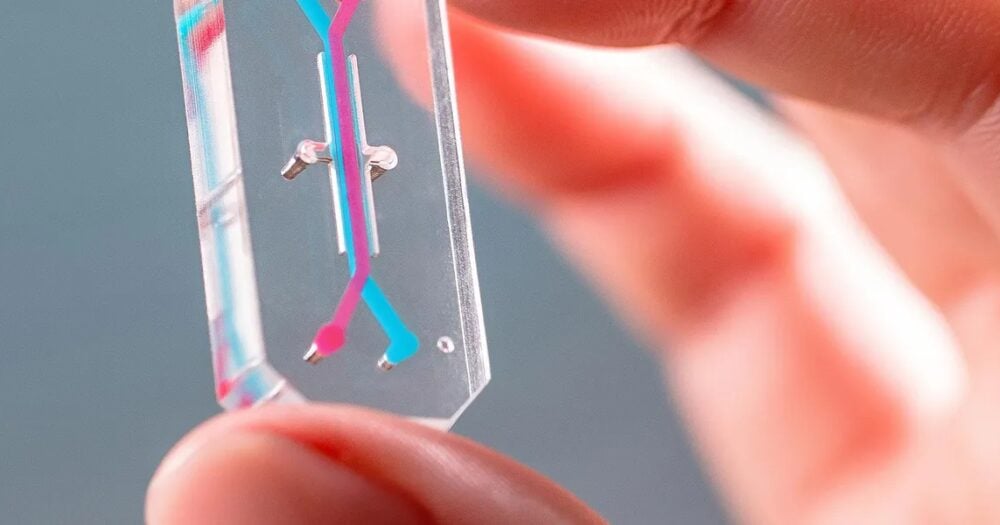
When the FDA recently told a pharmaceutical company it could not proceed to clinical trials because its animal data wasn’t enough, and that organ-on-a-chip data was needed instead, it marked something quietly extraordinary. Fifteen years ago, the same agency’s peer reviewers were asking researchers to add mouse experiments to validate their early chip-based models. The standards have reversed direction entirely.
That reversal is the backdrop for one of the more interesting tensions in biomedical research right now. The technology to model human biology without animals has advanced well past proof-of-concept. What’s lagging is everything else: the regulatory frameworks, the training pipelines, the professional habits built up over decades of animal-based science.
What organs-on-a-chip actually do
The story starts in 2010, when cell biologist Donald Ingber and colleagues at Harvard’s Wyss Institute published a paper in Science describing a model human lung smaller than a USB stick. The device used narrow microfluidic channels lined with human lung and blood vessel cells, and it physically expanded and contracted when air was pumped through adjacent chambers. It breathed. When exposed to bacteria, the model mounted an inflammatory response. When exposed to silica nanoparticles, it revealed that physical movement affected how lung tissue absorbed them. Static tissue cultures had never been able to show that. The paper has since been cited by nearly 5,400 other studies.
That lung chip was an early example of what researchers now call NAMs, or new approach methodologies. The category includes organoids, computational organ simulations, AI-assisted analysis tools, and multi-organ chip systems that link up to ten organ models together to approximate human physiology. None of these systems are perfect. But the argument made by their developers is not perfection — it’s that they already outperform animal models on many of the questions that matter most in drug development.
Why animal models have real limitations
Around 92 percent of drugs that enter U.S. clinical trials never reach the market. Many fail because they prove ineffective or unsafe in humans in ways animal testing didn’t predict. Failure rates are especially high in cardiovascular disease, oncology, and neurology. This isn’t entirely the fault of animal models — flawed study design and the sheer complexity of disease also play a role. But the pattern is consistent enough that researchers have long questioned whether mice and monkeys are adequate surrogates for human biology.
Some go further. There’s a plausible case, made by more than a few scientists, that drugs like aspirin or acetaminophen might have been abandoned during preclinical testing if they were discovered today, because of how they behave in certain animal models.
Regulation finally opened the door
For years, U.S. drug regulations effectively mandated animal testing before human trials. That changed in late 2022, when the FDA Modernization Act 2.0 became law. It explicitly authorized NAMs as valid evidence in preclinical drug studies. For researchers who had spent years building the scientific case for alternatives, it was a long-awaited shift.
But legal authorization is not the same as adoption. As Ilka Maschmeyer, a translational toxicology researcher and executive at German biotech company TissUse, puts it, cases where companies are actively required to use NAMs are still rare. The expectation is that they’ll become more common. Still, that process has a long way to go.
The real obstacle is change management
Thomas Hartung, toxicologist and director of the Center for Alternatives to Animal Testing at Johns Hopkins University, is direct about where the bottleneck is. “This transition process is much more complicated than you would think,” he says. “It is more about change management than it is about the technology.”
Validating NAMs at scale requires standardizing systems across labs, running head-to-head comparisons with animal experiments, and building enough of an evidence base that regulators and pharmaceutical companies feel confident relying on them. That takes time and coordinated effort. And it requires researchers trained in these methods — which means rethinking curricula in biomedical and pharmacology programs that have long centered on animal models.
- Standardization of NAM protocols across research institutions
- Regulatory guidance on what counts as sufficient NAM evidence
- Training programs for researchers and toxicologists
- Head-to-head validation studies comparing NAMs to animal models
- Cultural shifts within pharmaceutical R&D departments
The technology is not what’s standing in the way. That’s an important thing to understand about where this field actually is. The chips work. The organoids work. The computational models are getting better every year. What hasn’t caught up is the institutional infrastructure needed to make their use routine. That gap is closable, but it won’t close by itself.