

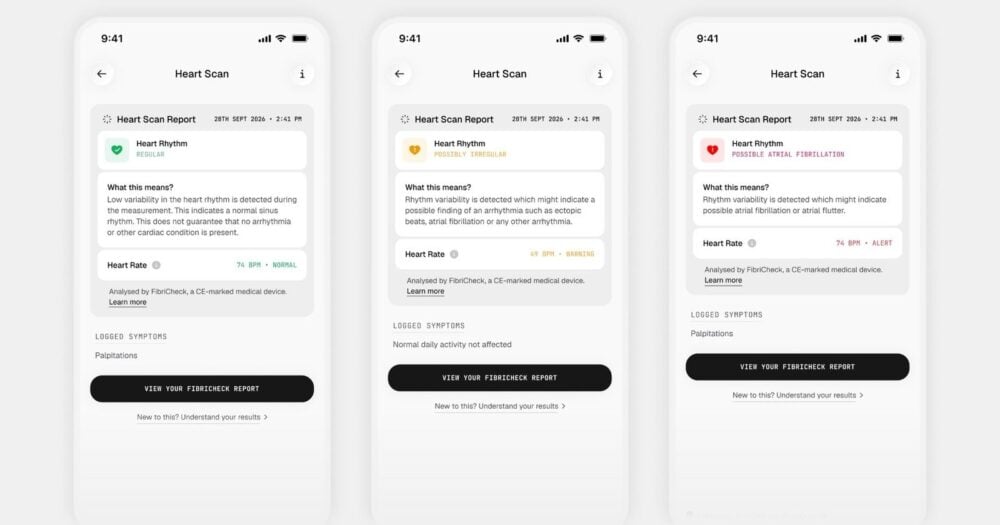
Most people don’t think about their heart rhythm until something goes wrong. And by then, the moment has often passed, unrecorded and unexamined. Ultrahuman is trying to close that gap with the launch of Heart Scan, a new feature that lets Ring Air and Ring Pro users check their heart rhythm on demand, any time they feel something isn’t quite right.
What Heart Scan does and how it works
The feature is built on a partnership with FibriCheck, a CE-marked app that uses a smartphone’s camera to capture photoplethysmography (PPG) data and screen for irregular heart rhythms. The process is simple: open the Ultrahuman app, hold still for 60 seconds, and let FibriCheck’s algorithm do the analysis. The results are compiled into a PDF that users can share directly with a clinician, giving the healthcare provider access to the actual rhythm recording rather than a vague summary of symptoms.
That last detail matters. Self-reported symptoms are notoriously unreliable. A structured, shareable output that a cardiologist or GP can actually review is a meaningful step up from a patient saying “I felt a bit funny earlier.”
How it fits into Ultrahuman’s existing AFib tools
Heart Scan isn’t a standalone product. It extends Ultrahuman’s existing Atrial Fibrillation monitoring, which passively tracks heart rhythm during sleep. The on-demand scan adds a daytime, symptom-triggered layer to that continuous monitoring. So instead of relying only on overnight data, users now have a way to capture what’s happening in real time when something feels off.
And for existing subscribers, there’s no additional cost. Heart Scan is being folded into the existing AFib Power Plug add-on. If you’re already paying for AFib monitoring, you get this too.
Availability and current limitations
The feature is rolling out now, but not globally. It is currently limited to supported markets across the UK, Europe, the Middle East, and Asia-Pacific. Users in the United States will need to wait, and Ultrahuman hasn’t confirmed a timeline for broader availability.
That’s a real limitation. AFib affects an estimated 6 million people in the US alone, and consumer demand for accessible cardiac monitoring tools is high. The regulatory path for cardiac software features in the US is more complex, which likely explains the phased rollout, but it means American Ring users are sitting this one out for now.
Why this kind of tool has real clinical stakes
AFib is the most common sustained cardiac arrhythmia in adults, and a leading cause of stroke. The problem is that it’s often paroxysmal, meaning it comes and goes. Patients may experience symptoms briefly and then feel completely normal, making it easy to dismiss or miss entirely in a standard clinical setting. Wearable monitoring that can capture a rhythm at the moment of symptoms has genuine diagnostic value.
- On-demand PPG-based rhythm scan triggered by the user
- 60-second recording analyzed by FibriCheck’s algorithm
- PDF output formatted for clinical review and sharing
- Integrated with existing sleep-based AFib monitoring
- Included in the AFib Power Plug add-on at no extra cost
Still, it’s worth being clear about what this is and what it isn’t. A PPG-based scan from a smartphone camera is a screening tool, not a diagnostic one. It can flag potential irregularities, but it does not replace a 12-lead ECG or Holter monitor. Clinicians will need to interpret results in context, and users should be guided not to self-diagnose based on the output.
The bigger picture
Consumer cardiac monitoring is maturing quickly. Apple, Samsung, Withings, and now Ultrahuman are all building rhythm-detection capabilities into everyday devices. The shift toward continuous and on-demand monitoring outside of clinical settings is real, and the data quality is improving. The challenge ahead is integration: getting this data into clinical workflows in a way that is useful, not overwhelming, for the providers on the receiving end. A clean, shareable PDF is a start. But as these tools scale, the healthcare system will need clearer protocols for what to do when patients arrive with a folder full of wearable rhythm data. That conversation is only just beginning.