

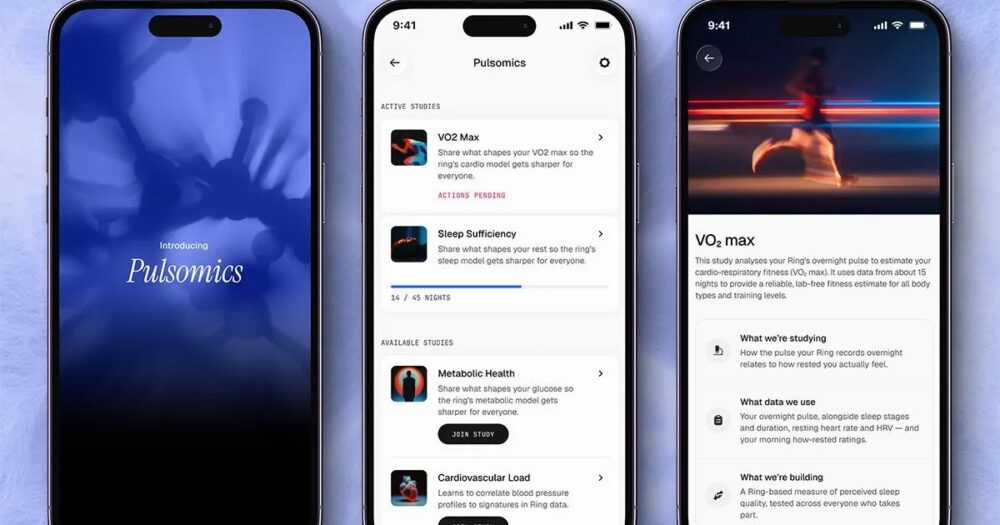
Consumer wearables generate enormous volumes of physiological data. Most of it sits inside an app, producing charts that users glance at and forget. Ultrahuman thinks that data could do something more useful, and it has now built a platform to make that happen.
The company has launched Pulsomics, a research platform that invites Ring Air and Ring Pro owners to enroll in formal wellness studies. Ultrahuman has contributed to health research before, but Pulsomics is the first time it has created a structured, opt-in system that makes the data-sharing process explicit and accessible to any user.
What Pulsomics actually collects
Signing up asks for more than the typical wearable onboarding form. Users provide age, sex, height, weight, ethnicity, and skin tone. That last data point matters more than it might seem. Optical heart rate sensors, the kind built into smart rings, can produce different signal quality depending on skin tone, and capturing that variable is necessary to train models that work fairly across a diverse population.
Vinayak Narasimhan, Ultrahuman’s head of science, describes the ambition clearly: “This will be the very first at-scale, free-living set of studies where we collect longitudinal wearable data from our users alongside extremely valuable user-provided context, like personal lifestyle and medical history, family history, demographics, and sometimes day-level journaling.”
That framing matters. Most clinical research is conducted in controlled environments with small, often homogeneous cohorts. Large-scale, real-world longitudinal data is genuinely hard to collect. If Pulsomics delivers on that premise, it could produce training datasets that are meaningfully more representative than what academic institutions typically have access to.
Three studies are open now
The platform launches with three active trials:
- A sleep study focused on individualized sleep need, moving beyond the generic “eight hours” recommendation
- A VO2 Max study using continuous ring data to refine aerobic capacity estimates
- A glucose metabolism study that correlates wearable data with a recent blood test panel, and therefore has stricter eligibility requirements
Future studies will include a cardiovascular load trial and a longer-term longitudinal sleep study. The platform is currently limited to Ring Air and Ring Pro users. Owners of Ultrahuman’s Home sleep monitor are not included at this stage.
The privacy question
Health data research always raises a reasonable question: who benefits, and at whose expense? Ultrahuman states that data is de-identified before use, is never sold, and is never shared with advertisers, employers, or insurers. Published findings use aggregated data only.
Those are standard commitments for any credible research program, and they align with what informed participants should expect. Still, users should read the enrollment terms carefully. “De-identified” is not the same as anonymous, and longitudinal health datasets carry inherent re-identification risk that any responsible platform needs to manage over time.
Why this matters beyond the product
Ultrahuman CEO Mohit Kumar points to something important when he describes the goal as predicting “everything from how much sleep you need to an individual’s organ function.” That is not marketing language. Personalized health predictions, the kind that account for individual biology rather than population averages, require exactly the kind of data Pulsomics is trying to collect.
The Ring Pro is currently available in the US at $479. That price point positions it as a premium consumer device, which means the Pulsomics participant pool will skew toward a specific demographic unless the company actively works to broaden access.
But the broader direction is worth watching. If consumer wearable companies can build research infrastructure that meets scientific standards, they sit on a data resource that most academic institutions and pharmaceutical companies simply cannot replicate at scale. That changes who gets to ask the questions, and who gets to build the models that eventually inform clinical care.