

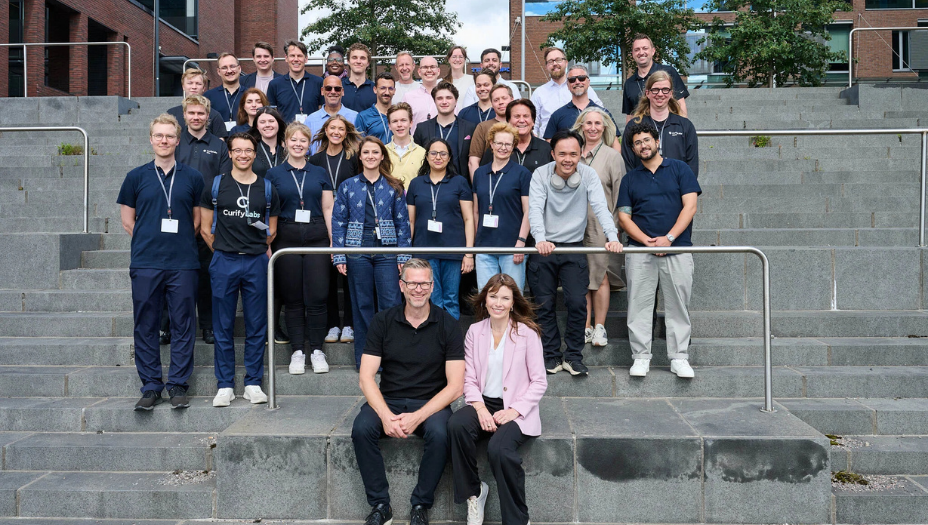
CurifyLabs, a Helsinki-based health tech company, has closed a €12 million ($14 million) Series A round to grow its U.S. footprint, strengthen its supply chain, and speed up product development. The round was co-led by Sandwater and HealthCap, with participation from Tesi (Finnish Industry Investment Ltd.) and existing investors including Lifeline Ventures.
The company makes a system that lets pharmacies produce personalised medications using 3D printing, replacing slow and error-prone manual compounding processes. Its technology is already in use across pharmacies in 21 U.S. states and several European markets, where it compounds thousands of doses daily.
This round follows a €6.7 million raise in May 2025, bringing CurifyLabs’ total disclosed funding to nearly €19 million. It also fits into a busy year for health tech infrastructure investment across Europe, with adjacent rounds in 2026 totaling roughly €149 million including this one.
What CurifyLabs actually does
Founded in 2021, CurifyLabs built what it calls a Compounding System Solution, or CSS. The platform combines three components:
- Proprietary software to manage the compounding workflow
- GMP-manufactured excipient bases, which are the inactive ingredients that hold medications together
- 3D printing hardware that automates the actual preparation of personalised doses
The result is a pharmacy system that can produce custom medications faster and with more consistency than manual methods. The company’s latest hardware, the PharmaPrinter Aurum, reportedly compounds up to nine times faster than doing the same work by hand.
The platform is ISO 13485 certified and built to comply with FDA 503A and 503B standards for non-sterile compounding, which are the regulatory frameworks that govern how U.S. pharmacies prepare customised medicines outside of standard commercial manufacturing.
Why investors backed the round
Personalised medicine, where drugs are tailored to individual patients rather than prescribed in fixed commercial doses, has been growing steadily as pharmacies look for ways to serve patients who need specific dosages, formulations, or combinations that off-the-shelf products can’t provide. The challenge has always been that manual compounding is slow, labour-intensive, and carries quality risks.
Morten E. Iversen, partner at Sandwater, said the team has built something that works in real pharmacy environments: “CurifyLabs has built something rare – technology that combines clinical rigor with the speed and precision that busy pharmacy teams depend on.”
HealthCap partner Daniel Karsberg, whose firm has backed more than 136 life sciences companies over nearly three decades, pointed to the founding team’s ability to combine scientific depth with practical execution as the deciding factor.
Tesi Investment Director Joni Karsikas framed the round as further evidence that Finnish health technology can compete internationally: “Their growth in the U.S. is further proof that Finnish health technology can compete and win on the world stage.”
What the money will fund
CurifyLabs CEO and founder Charlotta Topelius said the funding gives the company resources to raise its standards further across clinical quality and customer support. Specifically, the company plans to use the capital to:
- Expand U.S. operations
- Strengthen supply chain infrastructure
- Improve customer support for pharmacy partners
- Continue developing the CurifyLabs platform and hardware
A broader trend in health tech infrastructure
CurifyLabs’ round is part of a wider pattern of investment in health infrastructure this year. Other 2026 rounds in adjacent areas include ShanX Medtech’s €24 million raise for antimicrobial diagnostics, Astral Systems’ €26 million Series A for medical isotope supply, BioLamina’s €20 million EIB loan for cell therapy infrastructure, and SamanTree Medical’s €20 million EIB financing for surgical imaging, among others.
Across these deals, investors are consistently backing companies that solve operational bottlenecks in healthcare rather than pure drug development. CurifyLabs fits that pattern: it does not make the medicines itself, but it makes it significantly easier and safer for pharmacies to do so at scale.