

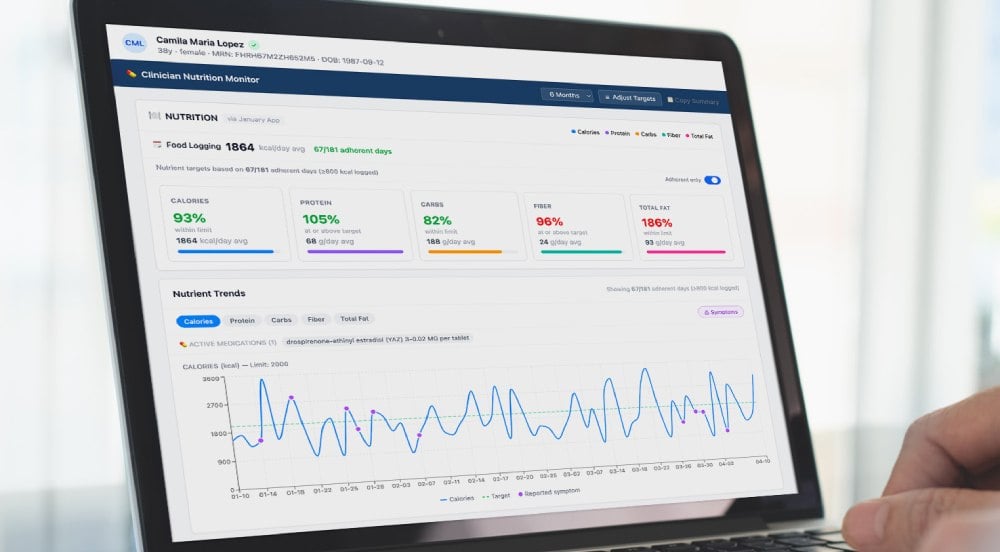
For most clinicians, what a patient eats between appointments is essentially a black box. Dietary recall is notoriously unreliable, and there has never been a practical way to connect day-to-day food choices with clinical data inside an electronic health record. January AI is trying to change that.
The Menlo Park-based health company announced that its Clinician Nutrition Monitor has been qualified as a solution on Mayo Clinic Platform. The tool pulls nutrition data logged by patients in the January AI app directly into Epic, the dominant EHR system used by hospitals and health systems across the United States. Clinicians see meal logs, nutrient trends, weight, BMI, and medication history in one view, with no separate login required.
The qualification matters because Mayo Clinic Platform does not rubber-stamp every product that applies. Each solution goes through an evaluation of intended use, clinical performance, and algorithmic fairness before it earns the qualified label. That process gives health systems a level of confidence that the tool has been independently reviewed, which is often a prerequisite for adoption at scale.
How the tool actually works
Patients log meals through the January AI app using a photo, voice input, barcode scan, or text search across a database of more than 54 million foods. That data is then aggregated and surfaced inside Epic, where clinicians can see it alongside existing clinical records.
The Clinician Nutrition Monitor is designed to answer a specific clinical question: is what this patient eats consistent with their care plan? To help with that, it combines several data streams in one place:
- Longitudinal meal logs with nutrient breakdowns
- Medication overlays to flag potential diet-drug interactions or alignment issues
- Weight trends and BMI over time
- Symptom tracking data from the patient app
Pre-built summaries and a copy-to-chart function let clinicians document nutrition-related findings without extra steps, which reduces the administrative load that has historically made nutrition harder to address in short appointments.
Why this is hard to do and why it has not been done before
Nutrition data has always been difficult to bring into clinical settings. Self-reported food diaries are inconsistent. Registered dietitian consultations are expensive and not always accessible. And even when patients do track what they eat, that information typically lives in a consumer app with no connection to the clinical record.
January AI’s approach is to sit on both sides of that gap. The consumer app handles the logging experience, while the EHR integration handles the clinical display. The company’s CEO and co-founder, Noosheen Hashemi, put it directly: “What patients eat between appointments profoundly shapes outcomes, yet that information has remained largely invisible to clinicians.”
That is not a new observation in healthcare. But previous attempts to solve it have either relied on manual data entry, required workflow changes that clinicians would not adopt, or produced data that was too noisy to be useful. An EHR-native tool that requires no additional login is a more practical approach, even if it depends on patients actually using the logging app consistently.
What Mayo Clinic Platform qualification means in practice
Mayo Clinic Platform is a program that helps digital health companies integrate their products into real clinical and administrative workflows. It evaluates tools against standards for accuracy, fairness, and intended use before granting qualification status.
Steve Bethke, vice president of Solution Developer Market at Mayo Clinic Platform, said the program is “committed to helping empower practical, impactful solutions to enhance patient care” through that qualification process.
It is worth noting that Mayo Clinic is explicit that qualification does not equal endorsement. The platform does not warrant the performance of third-party products, and terms of use sit between the end user and the developer. Still, the qualification process is more rigorous than most app store reviews, and health systems treat it as a meaningful signal when evaluating new tools.
January AI’s broader position in the market
January AI was co-founded by Hashemi and Dr. Michael Snyder of Stanford University. The company originally built its name around a predictive glucose monitor that estimates blood sugar responses to specific foods using a photo or barcode scan. It now reports around 200,000 users of that tool.
The company has been expanding into enterprise and clinical channels. Earlier this year, it was named among the first apps included in the CMS Medicare App Library, which gives it potential reach across more than 69 million beneficiaries. The Clinician Nutrition Monitor represents a different direction, embedding January AI into the clinical workflow rather than just putting it in patients’ hands.
The broader trend here is the push to make behavioral and lifestyle data, things like sleep, activity, and diet, a standard part of the clinical record rather than an afterthought. January AI is betting that nutrition is the most underserved piece of that puzzle, and that clinicians will use the data if it is easy enough to access. Whether patients log their meals consistently enough to make that data meaningful is the harder question, and one that no EHR integration can answer on its own.