

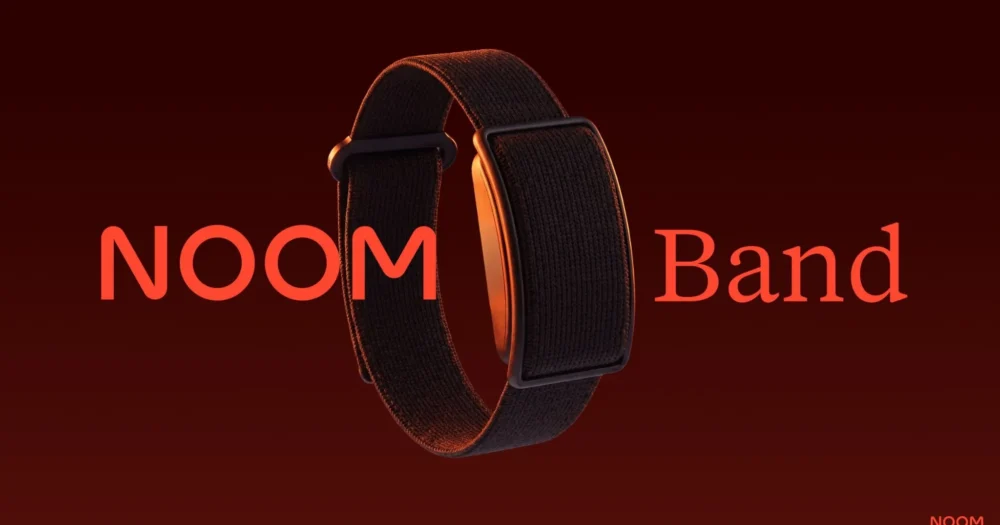
Free hardware is a strong sales pitch. Whether it is also a strong clinical one is a different question. Noom announced at HLTH USA 2026 that its new Noom Band will be included for all Noom Health employer and health plan clients in 2027, with no up-front cost to the payer.
What Noom is launching
The Noom Band is a wearable tied directly into Noom’s behavior-change programs. It tracks activity, sleep, heart rate, heart rate variability (HRV) and blood oxygen (SpO2). Sensor Bio, an Austin-based sensor company, supplies the hardware and the raw-data platform. Noom’s software then uses those signals to shape coaching and prompts.
The positioning is deliberate. Noom says most consumer wearables are built around athletic performance, while this one targets weight management and metabolic health. For payers, the company is framing it as a tool tied to outcomes they already fund, not a fitness perk that ends up in a drawer.
What the early data show
Noom shared two internal analyses. Both are unreviewed, and both deserve a careful read.
The first looked at 144,593 Noom Med users who started between September 2025 and July 2026. Among members on a GLP-1 medication, those who connected a wearable were 34% more likely to lose 20 pounds by month 4. But this was not a randomized comparison. Users had to connect a device in month 1, which selects for engaged people. Median starting BMI also differed slightly, 30.0 with a wearable and 29.4 without. Also, the analysis covered connected wearables in general, not only the Noom Band.
The second analysis drew on clinical trial participants. Among 499 members who received the band, sleep rose by an average of 12.98 minutes per night (95% CI 10.24 to 15.78). In a subgroup of 103 members who started under 7 hours a night, the gain was 21.44 minutes per night (95% CI 14.60 to 29.11) over the first two months. Noom frames this as 90 extra minutes a week for GLP-1 users, and 150 minutes a week for those starting with a sleep deficit.
Those are modest, plausible gains. There is no control group described, though, and no evidence yet that more sleep drives additional weight loss or better metabolic markers.
Why it matters
GLP-1 drugs have pushed employers and health plans into a hard spot. They want better results from expensive prescriptions, and they want proof that lifestyle support improves adherence and outcomes. Wearables offer a continuous stream of data between clinical touchpoints. Bundling the device into the program removes a cost barrier that has limited many digital health pilots.
Sensor Bio’s pitch adds another angle. It gives partners access to raw physiological data, not just processed scores, and its sensors have appeared in peer-reviewed validation studies. That matters to clinicians who want to know what a device actually measures.
What to watch
The key test is peer-reviewed, controlled evidence tied to the Noom Band itself. Clinicians and buyers should look for comparisons against matched non-wearable users, retention beyond month 4, and outcomes beyond the scale, such as glycemic markers and blood pressure. Noom has pointed to earlier randomized trials for its program. The band now needs its own.
Until then, the launch is a credible product strategy with encouraging but preliminary signals. Payers will decide in 2027 whether it becomes more than a free gadget.