

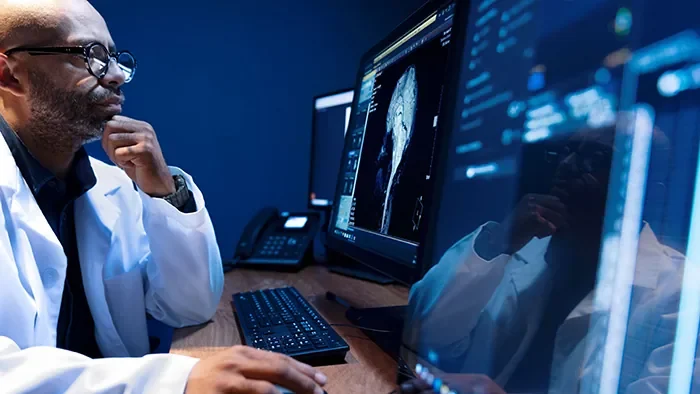
Radiology doesn’t have an AI shortage. It has an AI sprawl problem. Every new algorithm tends to arrive with its own login, its own viewer and its own way of sending results back, and radiologists end up doing the stitching by hand. Philips says its new Advanced Image Insights is meant to fix that.
The cloud-based solution combines Philips advanced visualization applications with central management of third-party AI tools. It connects to Philips HealthSuite Imaging PACS, so analysis results land next to the diagnostic images instead of in a separate system. Philips will show it at RSNA 2026 in Chicago, booth #6730.
How it works in practice
Philips gives a lung CT example. In the background, one AI application screens for incidental pulmonary embolism while another supports quantitative lung nodule assessment. Both results appear in the radiologist’s workflow for review alongside the images.
Philips Interactive Reporting Assistant then pulls findings, key images and AI results into a structured multimedia report with hyperlinks, tables and graphs. Voice recognition, automatic template selection and data population are built in, which cuts repetitive documentation and manual data transfer.
Radiologists stay responsible for reviewing images and AI outputs and for the final interpretation. That’s the right framing, and the company states it plainly.
Delivery and caveats
The product is a managed software-as-a-service offering on Philips HealthSuite, powered by AWS. Philips runs the infrastructure, which should reduce IT burden for sites adding subspecialties or locations.
Some fine print matters. Each application keeps its own intended use and regulatory status, and availability varies by market. Philips has not released performance data or named which third-party AI vendors are included.
Why it matters
Imaging volumes and study complexity keep rising while staffing stays tight. Orchestration layers are becoming the main battleground in imaging informatics, because hospitals want algorithms to fit the workflow rather than add to it. As Madhuri Sebastian of Philips put it, the opportunity is not simply to add more AI applications, but to make them work better across the diagnostic journey.
The real test will be whether departments see fewer clicks and faster reports in routine use. That evidence is still to come.