

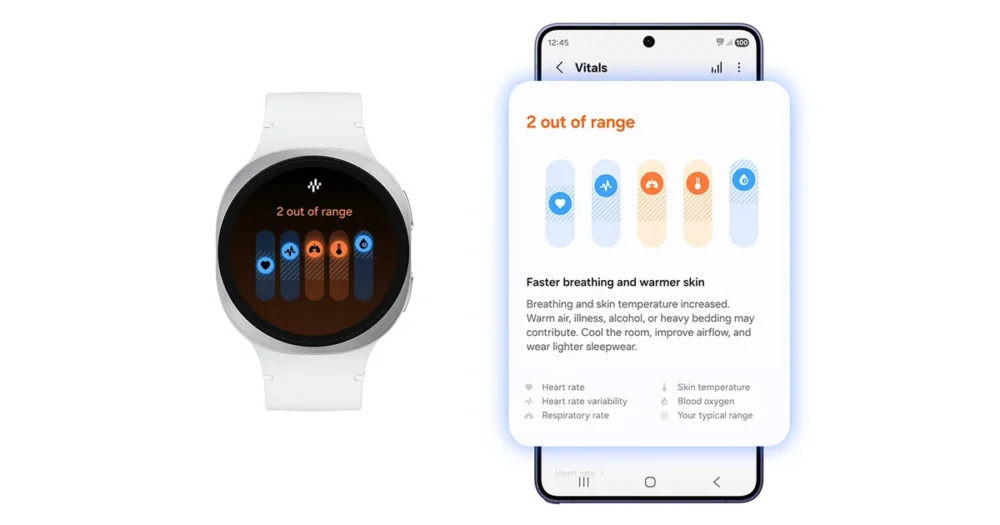
Samsung is giving owners of last year’s watches something wearable makers rarely do: the new model’s best health features, delivered through software. The One UI 9 Watch update brings tools first seen on the Galaxy Watch 9 and Galaxy Watch Ultra 2 to the Galaxy Watch 8 and Galaxy Watch 8 Classic. The rollout began in mid-November, though timing varies by country, model and carrier.
The headline addition is Vitals, which tracks five signals overnight: heart rate, heart rate variability, respiratory rate, skin temperature and blood oxygen saturation. It builds a personal baseline over time and flags notable deviations from it. That baseline approach matters more than any single reading. A resting heart rate of 62 means little on its own, but a sustained shift from your own normal can be a useful prompt to rest, recheck or talk to a doctor.
Heart Health Score rolls sleep, activity and other indicators into one figure. Samsung is clear that neither Vitals nor Heart Health Score is meant to diagnose or treat a medical condition. They are wellness tools, and clinicians should treat the numbers as conversation starters, not findings.
Two training-focused features come along too. Daily Cardio Load measures the strain that workouts and everyday activity place on the heart, then suggests a load range for exercise and recovery. Fitness Index combines several metrics into a single overview and can recommend matching workouts. Both follow a pattern already common on Garmin, Whoop and Polar devices, where the goal is guiding effort, not just counting steps.
Sleep gets the most substantial upgrade. Sleep Coaching can start with just three days of sleep data from the past two weeks, and it offers weekly guidance that adapts as your patterns change. The upgraded Sleep Apnea feature is the regulated piece of the package. It received US FDA clearance in July 2026 and approval from Korea’s Ministry of Food and Drug Safety in October 2026.
It uses AI to review how often breathing disruptions occur per hour of sleep, then sorts results into minimal, occasional or frequent. Results appear in the Samsung Health Monitor app after two valid nights within a 10-day period. That is a modest data requirement, and it lowers the barrier for people who would never book a sleep study unprompted.
That is the real clinical significance here. Sleep apnea is widely underdiagnosed, and many patients only seek help after a partner complains about snoring or after years of poor sleep. A wrist-worn screening tool will not replace polysomnography. But if it nudges even a fraction of at-risk users toward a proper evaluation, it does useful work. The caveat is that screening tools can also generate worried users with borderline results, so primary care teams may see more of those conversations.
The update also includes a few non-health extras: a Portrait Watch Face that recognizes people in photos and arranges the clock around them, Compass waypoints, and Track Back for retracing a route. Some tools require a separate update to the Samsung Health or Samsung Health Monitor app, so users may not see everything the moment the watch software lands.
The timing says something about Samsung’s strategy. Reports suggest the company may skip a 2027 Galaxy Watch hardware refresh, and this release looks like a way to keep current watches competitive without new silicon. For buyers, that is good news. A watch purchased last year keeps gaining value instead of aging out after twelve months.
It is also a sign of where the wearables market is heading. Sensors have largely plateaued, so differentiation now comes from algorithms, baselines and regulatory clearances. Samsung has no pricing to announce because the update is free, but availability will be uneven, and the sleep apnea feature in particular depends on regional approval. Users outside the US and Korea should check whether it is enabled before counting on it.